On the sidelines of the 81st United Nations General Assembly in New York, Nigeria’s Minister of Solid Minerals Development, Dele Alake, and United States Deputy Secretary of State Christopher Landau signed a framework agreement to deepen American investment in Nigeria’s mining sector — a sector the Federal Government values at an estimated $700 billion in untapped mineral wealth. The agreement, signed at Nigeria’s Mission House, commits both countries to cooperation across four areas: geological data and exploration, mineral development and processing, infrastructure, and technical capacity. Alake was explicit about what Nigeria wants from it. “We are not here to remain a source of raw material for the value that others create,” he said. “Our goal is to turn potential into lasting value at home through stronger local processing, new skills, quality jobs, and new opportunities for Nigerian businesses.”
| WHAT THIS MEANS FOR NIGERIA’S MINERAL EXPORTS TODAY |
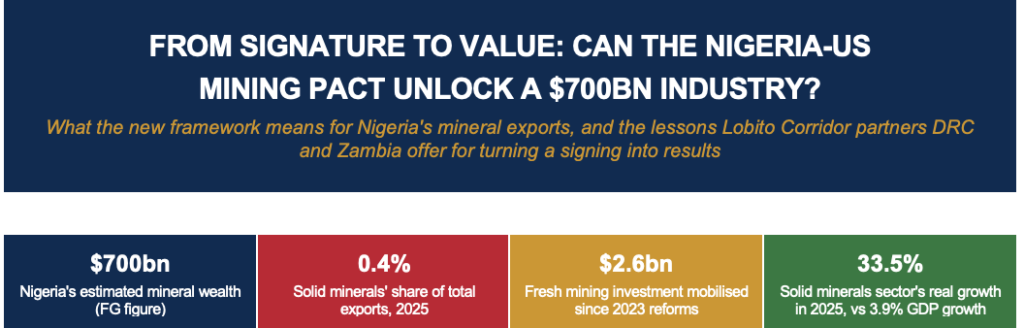
The scale of the opportunity is matched only by the scale of the current underperformance. Despite holding more than 44 commercially viable minerals across over 500 locations, solid minerals still contribute less than 1 percent of Nigeria’s GDP, and solid mineral exports totalled just ₦354 billion in 2025 — roughly 0.4 percent of Nigeria’s total exports and about 3 percent of non-oil exports, down from nearly 5 percent of exports at independence. The momentum, however, is real: federation revenue from the sector rose from ₦16 billion in 2023 to ₦38 billion in 2024 and over ₦70 billion in 2025, with the sector posting 33.5 percent real growth in 2025 against overall GDP growth of just 3.9 percent. Reforms since 2023, including a licensing regime that now denies mining licences without a clear local-processing plan, have already mobilised about $2.6 billion in fresh investment commitments, headlined by a $1.3 billion, 1.5-million-tonne alumina refinery — the largest single mining investment in Nigeria’s history.
Yet the underlying export pattern the new pact must correct is visible in the most recent trade data. Solid mineral exports jumped over 80 percent in the first half of 2026 to ₦249.7 billion — but the surge was drawn heavily from unprocessed shipments of lithium, zinc, lead and tin ores, with foreign smelters and battery makers capturing the industrial value-add while Nigerian communities receive comparatively modest pit-head revenue. This is precisely the raw-export trap Alake has pledged to end, and it is the trap the US framework’s emphasis on “mineral development and processing” is designed to help close — provided the geological data and technical capacity it promises actually translate into processing plants on Nigerian soil, rather than simply making it easier to locate and ship out more raw ore.
| LESSONS FROM OTHER US MINERAL PARTNERSHIPS |
Nigeria is not the first African nation to sign this kind of framework with Washington, and the experience of the Democratic Republic of Congo and Zambia offers a genuinely instructive playbook. In December 2025, the US and the DRC signed a Strategic Partnership Agreement giving America preferential access to Congolese mineral deposits — the latest step in a partnership that began with a 2023 memorandum of understanding to build the Lobito Corridor, an approximately 1,300-kilometre rail and infrastructure link connecting the copper- and cobalt-rich Copperbelt of the DRC and Zambia to Angola’s Atlantic port of Lobito. Crucially, that partnership did not stop at a signing ceremony: the US alone has committed roughly $4 billion to the corridor, total commitments from the US, EU, African Development Bank and private investors now exceed $6 billion, and the first shipment of Congolese copper reached the US market by August 2024, less than a year after the founding agreement.
Three lessons stand out. First, minerals cannot move without infrastructure: the Lobito partners paired mineral access directly with a concrete, financed logistics corridor, rather than treating exploration rights and infrastructure as separate problems to be solved later. Nigeria’s own mineral-rich states — Nasarawa, Plateau, Zamfara, Kebbi among them — face similar bottlenecks getting ore and processed minerals to port, and the new US framework’s infrastructure component should be tied to specific corridor projects from the outset, not left as a vague aspiration. Second, Zambia in particular has shown the value of negotiating from strength rather than simply granting access: it has used shared infrastructure as its point of leverage while preserving sovereign control over how its mineral wealth is allocated, extracting technical assistance, feasibility funding and equity investment on its own terms. Nigeria’s existing no-raw-export-without-processing policy already reflects this instinct, and it should be applied consistently across all 44 commercial minerals, not just lithium, as the US partnership scales up. Third, execution takes years of sustained, measurable follow-through, not a single signature — exactly the point Alake himself made when he said implementation would now be the focus, because “a signature is a promise, results are the proof.”
| HOW NIGERIA CAN MAXIMISE THE PACT |
Four priorities would give Nigeria the best chance of avoiding the raw-export trap and replicating Lobito’s better outcomes. First, use the agreement’s geological-data component to close Nigeria’s chronic exploration-data gap quickly, but publish the resulting data transparently so multiple investors — not only American ones — can bid for processing partnerships, preserving the competitive leverage that has served Zambia well and guarding against the kind of single-partner overexposure already visible in Nigeria’s oil trade relationships. Second, insist that every dollar of American investment mobilised under the framework be explicitly tied to a domestic processing or refining commitment, extending the lithium precedent across gold, tin, iron ore and the rest of the mineral portfolio. Third, pair the mining pact with real infrastructure investment — rail and road corridors linking mining states to Nigerian ports — rather than assuming processed minerals will simply find their own way to market. Fourth, build transparency, environmental safeguards and community benefit-sharing into implementation from day one; the oversight and governance concerns already raised by observers of the Lobito Corridor are a preview of scrutiny Nigeria’s own deal will attract, and it is far cheaper to design those safeguards in now than to retrofit them after a controversy. Handled this way, the Nigeria-US mining framework could do for the mineral sector what a decade of NEPC campaigns has struggled to do for agriculture: turn a resource Nigeria has always had into an export industry it actually controls the value of.