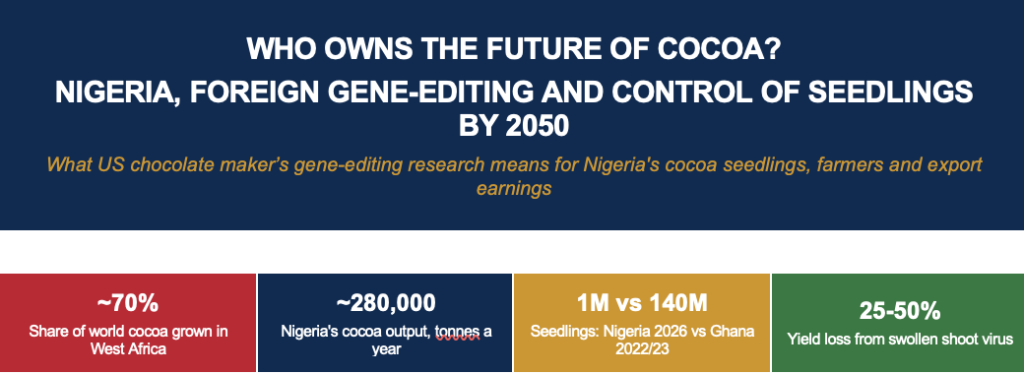
In August 2025, Mars, Incorporated, the American maker of M&M’s, Snickers and Galaxy, licensed the Fulcrum CRISPR gene-editing platform from Pairwise, another US company, to look for cocoa traits that resist disease and tolerate heat and drought. It had earlier begun a similar effort with University of California, Berkeley scientists. The United States grows almost no cocoa commercially. West Africa grows about 70 percent of the world’s supply. So a company in a country with no cocoa farmers is now racing to engineer the tree on which Nigerian, Ghanaian and Ivorian livelihoods depend. The science may help. The question for Nigeria is who will own the result, and who will control the seedlings that carry it.
| WHY THE RESEARCH IS HAPPENING |
The research is a response to real trouble. A study by the International Center for Tropical Agriculture (CIAT) projects that cocoa conditions in West Africa will be very different by 2050, with declines possible from around 2030 and suitable land within 300 kilometres of the coast shrinking sharply. Heat draws more water from the soil, and West African soils are less likely to be refilled by rain. Disease is already biting. Cocoa swollen shoot virus, spread by mealybugs, cuts yields by 25 to 50 percent and kills infected trees within three to five years. It has reached 11 of Côte d’Ivoire’s 13 main cocoa regions, where output fell 18 percent between 2020/21 and 2024/25. In Ghana, about 500,000 hectares, roughly 26 percent of the cocoa area, were affected in 2024 and output fell about 40 percent to some 600,000 tonnes. With prices near $13,000 a tonne in December 2024, Mars has every commercial reason to want a tougher tree. Cacao takes three to five years to mature, so conventional breeding is too slow.
| NIGERIA’S COCOA: HIGH EARNINGS, THIN FOUNDATIONS |
Nigeria has gained from the crisis without fixing its own base. Cocoa export revenue reached N1.32 trillion in the first quarter of 2025, against N36.67 billion in the first quarter of 2021, and cocoa made up 77 percent of agricultural exports. But the rise came largely from prices and a weaker naira. Output has stayed near 280,000 tonnes, although cocoa farmers say it could approach 600,000 with support. Our trees are old and our planting is thin. The Federal Government flagged off one million improved seedlings at the Cocoa Research Institute of Nigeria (CRIN), Ibadan, on 1 July 2026. At about 1,100 trees a hectare, that is roughly 900 hectares. Ghana’s COCOBOD raised 140 million hybrid seedlings for the 2022/23 season from 650 nurseries. That gap in scale is where outside control can creep in.
| WHO CONTROLS THE SEEDLING CONTROLS THE FUTURE |
The seedling is the real battlefield. Whoever controls the genetics controls yield, cost and the farmer’s dependence. The Plant Variety Protection Act 2021 gives breeders exclusive rights to commercialise seed and propagation material of a protected variety. That is good for Nigerian breeders, but the same right would protect a foreign company’s edited variety. Nothing public says what Mars or Pairwise intend on ownership, licensing or farmer access, and that silence is itself the risk. Four things could go wrong: the variety Nigeria needs arrives late, priced beyond smallholders or tied to licence conditions; resistance genes found in local trees are used with no return to Nigeria; a company’s priority, secure supply for its own factories, is not the same as the national priority of farmer income; and Ghana and Côte d’Ivoire, which agreed a joint 2026 to 2031 swollen shoot strategy including resistant varieties, move ahead while Nigeria is not at the table. None of this means refusing the research. Public-interest science and private capital can work together, on terms Nigeria writes.
There is an upside if Nigeria plays it well. Faster gene-edited varieties could shorten the years a farmer waits for a productive tree and cut losses to disease. Nigeria also has what the laboratories need: diverse local trees, field sites in the humid south-west and south-south, and the research base of CRIN and its neighbouring institutes at Ibadan. Genetic resources are bargaining chips. A country that can offer trial sites, data and skilled scientists is a partner, not a supplier of raw material, and partners negotiate licences, jobs and technology transfer. A country that waits to be offered seed will accept whatever terms are on the table.
| A FIVE-POINT PLAYBOOK TO END THE PROBLEM FOR GOOD |
Five steps would end the problem rather than manage it. First, declare cocoa germplasm a strategic national asset. Require material transfer and benefit-sharing agreements for any access to Nigerian trees, enforce them through the seed council and biosafety agency, and make licences for any variety derived from local material include royalty-free or low-cost access for Nigerian farmers. Second, make CRIN the sovereign seed authority, with a statutory multi-year budget, expanded clonal gardens and seed gardens, and its own gene-editing capacity guided by the National Biosafety Management Agency’s genome-editing rules, so that Nigeria can test, certify and, where sensible, co-own improved varieties. Third, scale planting to Ghana’s league: certified community nurseries across Ondo, Ogun, Osun, Oyo, Edo and Cross River, producing tens of millions of seedlings a year, with tagged, traceable planting material and strict quarantine against swollen shoot. Fourth, negotiate with Mars and its peers from strength and alongside Ghana and Côte d’Ivoire, through a West African cocoa research and genebank alliance, requiring open testing of resistant varieties in Nigerian conditions, local trials and shared data. Fifth, protect farmers while trees change: shade and agroforestry, irrigation where possible, income from intercrops like oil palm and cashew, and processing at home so that Nigeria earns from chocolate ingredients and not only beans.
The Mars and Pairwise project is neither villain nor saviour. It is a signal that the next cocoa battle is over seeds, and that the answer to 2050 will be written in laboratories long before it is planted in Ondo. If Nigeria owns its germplasm, funds CRIN, plants at scale and sits at the table, foreign research becomes an input to Nigerian prosperity. If it does not, our farmers may one day buy back the genetics of their own trees.