
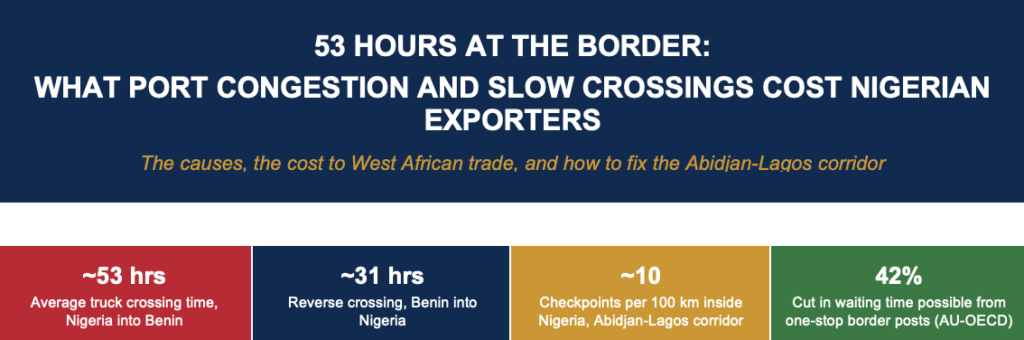
At a panel on regional growth corridors at the 32nd Nigerian Economic Summit in Abuja this week, speakers described a problem exporters already know too well. Trucks on the Abidjan-Lagos corridor take an average of nearly 53 hours to cross from Nigeria into Benin, and about 31 hours in the reverse direction, according to a 2024 corridor-organisation study cited by the International Organization for Migration. At the same time, containers sit too long in congested Nigerian ports. Non-oil exports are rising and the rest of Africa is now the largest destination category. The roads, borders and ports that must carry that growth are not keeping pace.
| THE CORRIDOR BY THE NUMBERS |
The corridor is the main artery of West African trade. It runs about 1,080 kilometres across Nigeria, Benin, Togo, Ghana and Côte d’Ivoire, carries over 50 million tonnes of freight a year, and handles about 70 percent of the sub-region’s transit trade. Analysis by the Centre for the Promotion of Private Enterprise puts the transit time at around ten days, with border waits of up to 52 hours at crossings such as Seme-Krake, about ten checkpoints for every 100 kilometres inside Nigeria, and informal payments of 50 to 120 dollars a trip. Seme-Krake is formally a joint border post, yet the Nigerian and Beninese customs administrations admitted in September 2026 that significant technological and operational gaps remain between them.
| WHAT IS CAUSING THE DELAYS |
Three layers of cause stack on top of each other. The first is the port. Customs officers at the Lilypond Export Command have said the electronic call-up system for trucks has too few slots, so containers stay stranded, and that export boxes wait behind import cargo, especially fast-track containers. Apapa is the most congested gateway, while Tin Can performs better because it has an export processing terminal. The APM Terminals Nigeria chief executive pointed out that the ports rest on pre-independence infrastructure and that cargo moves almost entirely by truck. The second is the border. Customs, immigration, standards and security agencies on each side repeat inspections, paperwork is largely manual, and the two systems do not yet see each other’s declarations. The third is governance. The IOM’s regional director said the gap is weak implementation and limited capacity among border officials, not a shortage of policy. The federal government cut Lagos-Seme expressway checkpoints to two, at Gbaji and Agbara, in October 2025, but analysts warn that checkpoints removed by order have a habit of returning within weeks.
| WHAT IT MEANS FOR EXPORTERS AND THE AFCFTA |
The implications for exporters are direct. Delay is a cost: it eats working capital, raises haulage and storage charges, and breaks delivery schedules. Processed foods, fresh produce and other perishables lose value by the hour, and a buyer in Accra or Abidjan who waits for a late truck will order from a competitor. Informal payments make costs unpredictable, which hurts small exporters most because they cannot absorb surprises. For the AfCFTA, which covers about 1.4 billion people and 3.4 trillion dollars in combined output, the lesson is blunt: a tariff schedule means little if goods spend two days at one border. West African trade is also where Nigerian MSMEs are most likely to start. The Botswana trade mission, in which one firm received an order for 6,000 T-shirts and another sold out of packaged jollof rice, shows the demand exists. Logistics decides whether it is captured.
| HOW TO FIX IT |
The fixes are known, and several have started. Port side: expand call-up slots and keep a protected lane for export containers; extend the Tin Can export processing model to Apapa and Lilypond; add scanners, as APM Terminals did when it cut average import container stay from 18 days to 14; move cargo by rail and barge; and allow private operators into port management, which its CEO framed as modernisation rather than asset sales. The National Single Window went live for imports in March 2026, and its export process is due at the end of November, so exporters should insist that every agency uses it and none keeps a parallel paper process. Border side: finish the one-stop border post at Seme-Krake with shared inspection, a joint information system and real-time data exchange between Nigerian and Beninese customs. An African Union and OECD study estimates that one-stop border posts can cut waiting time by 42 percent. Corridor side: hold to the two-checkpoint rule with published enforcement and a hotline, install weighbridges and scanners that work, and adopt an ECOWAS-wide transit guarantee so trucks need not be reinspected at each frontier. Finally, publish a quarterly corridor performance dashboard, with hours at each crossing and costs per trip, so that progress is measured and not claimed.
Alternatives to the road also deserve attention. Direct air-cargo links to Southern and Eastern Africa, starting with Uganda Airlines and later RwandAir, are reported to cut cargo costs by 50 to 70 percent on routes where road and sea are slow. Shipping to West African ports by sea needs scheduled Nigerian-linked services, and analysts at a recent shippers seminar named the lack of indigenous vessels as a structural gap. Rail and inland waterways can take bulk cargo off the trucks that now jam the ports. No single mode will replace the corridor, but a mix lowers the risk that one blocked border stops a shipment.
| WHAT EXPORTERS CAN DO NOW |
Exporters can also protect themselves now. Plan shipments around port call-up and border opening times, lodge e-Form NXP and supporting documents early so paperwork never holds a truck, insist on pre-agreed delivery windows in contracts, price in the delay risk, and report extortion and overcharging through trade associations and the relevant agencies so that the problem appears in data and not only in anecdotes.
Nigeria has the products, the buyers and the trade agreements. What it still needs is speed. If the single window for exports is delivered on time, if the Seme-Krake post works as a true joint facility, and if checkpoints stay down, the 53-hour crossing can shrink to a fraction of that and West Africa can become the home market that Nigerian exporters have long been told it would be.