On 14 December 2026, Nigeria’s National Single Window (NSW) begins processing exports. For the first time, an exporter should be able to apply for the certificates, permits and inspections needed to ship goods through one online platform, instead of visiting agency after agency. The NSW Secretariat says the second phase will bring export registrations, licences, permits, certificates, inspections and approvals onto the platform in two batches. It is the most significant reform of Nigerian trade procedure in a generation, and it arrives after a difficult first phase.
| WHY NIGERIA NEEDS A SINGLE WINDOW |
The need is easy to state. A trader has long had to submit similar documents to many agencies, each with its own forms, fees and timelines. In a November 2024 consultation, exporters named seven major barriers, and more than half were linked to fragmented institutions, duplicated procedures, poor coordination and inconsistent rules. The cost is large. Official statements put port costs up to 40 percent above those of neighbouring countries and annual losses at about N2.5 trillion, while the policy group SEREC estimates cargo-clearing inefficiency at N500 billion to N900 billion a year and notes that cargo is being diverted to Cotonou, Lomé and Tema, which already run harmonised digital platforms. The secretariat’s long-term aim is 24-hour clearance, against about 21 days today, and it projects benefits of about 2 billion dollars a year.
| HISTORY: FROM FAILED ATTEMPTS TO 2026 |
The idea is not new. Earlier attempts, around 2009 and 2010 and again around 2012 and 2013, failed. SEREC attributes such failures to inter-agency rivalry, weak implementation frameworks and vested interests. The current effort began when President Bola Tinubu inaugurated the project on 16 April 2024, and in July 2025 he set a 2026 deadline for completion. A steering committee chaired by Dr Zacch Adedeji, now Executive Chairman of the Nigeria Revenue Service, drives it, the Minister of Industry, Trade and Investment, Dr Jumoke Oduwole, leads implementation, and Tola Fakolade directs the secretariat. The contractor is CrimsonLogic of Singapore, with a design drawing on systems in Benin, Djibouti and Kenya, and Customs’ B’Odogwu platform sits behind the single window. Phase 1 went live on 27 March 2026, deliberately without a ceremony.
| THE THREE PHASES |
The rollout has three phases. Phase 1 covers import permits for non-oil goods, manifest submission by shipping lines and airlines, and a centralised risk-management system. Phase 2 covers all non-oil export processes. Batch one, from 14 December, covers the Nigeria Agricultural Quarantine Service, the Standards Organisation of Nigeria (including its SONEXCAP export conformity certificate), NAFDAC, NACCIMA, the Federal Produce Inspection Service and the Registered Exporter System. Batch two, expected in the first quarter of 2027, covers the Central Bank, Customs, the livestock and marine ministries, NEPZA, the Ministry of Finance, and later commercial banks and pre-shipment inspection agents. Phase 3, also planned for the first quarter of 2027, covers customs declarations, full integration and the oil and gas sector. Two dates matter to exporters. Customs must publish a list mapping HS codes to the regulating agencies by 1 December 2026, and from 1 January 2027 the system is meant to block transactions that lack required permits. The Trade Monitoring System is being integrated, and the export documentation process, e-Form NXP, will start from the NSW.
| PROGRESS AND TRANSACTION DATA |
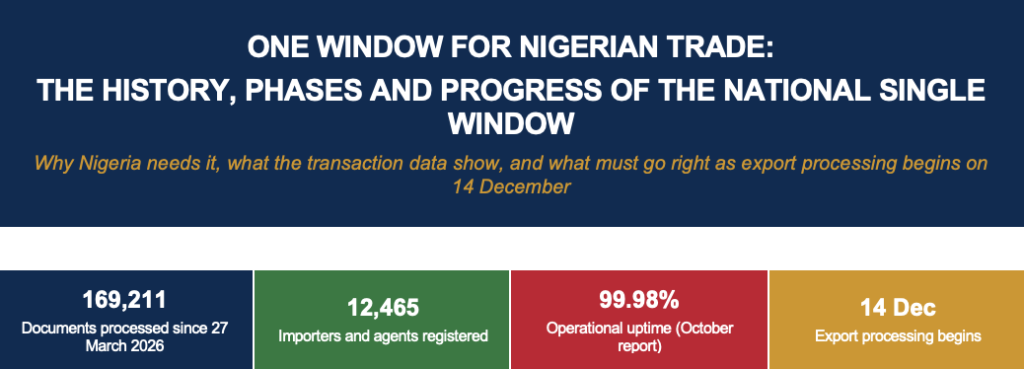
The numbers show real use. According to the October 2026 performance report, the NSW had processed 169,211 licences, permits and other documents since 27 March, with 12,465 importers and agents registered, 27 airlines and 56 shipping lines onboarded, 4,009 air cargo manifests and 405 sea manifests submitted, and uptime of 99.98 percent. An earlier September update, when the count stood at about 124,000, reported roughly N12.59 billion in regulatory payments, including over 85,000 documents and N9.95 billion at SON and 38,985 documents and N2.59 billion at NAFDAC. Five agencies were then fully onboarded: SON, NAFDAC, Customs, the Quarantine Service and NESREA. More than 8,000 users had been trained, and stakeholder sessions are running in eight locations, including Enugu, Akure, Jos, Ikeja, Badagry, Port Harcourt, Kano and Abuja.
| CHALLENGES |
The progress came at a cost. After launch, integration glitches contributed to trapped cargo, congestion and rising demurrage and storage charges, and some clearing agents and importers asked for suspension. SEREC blamed a rollout that was not phased, with simultaneous deployment at large and small ports and no pilot. The secretariat acknowledged early technical problems, which it says were fixed. Minister Oduwole put the lesson plainly: go-live is not the same as readiness. Deadlines have also slipped: Phase 2 was first due in the second and third quarters of 2026, then in late November, and now begins on 14 December with part of it in 2027. The Nigerian Ports Authority and NIMASA are not yet onboarded, partly because they are changing their payment platform. The Central Bank integration is reportedly about 80 percent complete, and exporters of solid minerals still complain of slow certificates and permits that expire before cargo reaches the port.
| WHAT WOULD MAKE IT WORK |
Four things would help most. First, agencies should sign service-level agreements with published turnaround times, so that a delay is visible and someone is accountable. Second, a hybrid fallback should stay available for exporters until the system proves stable, since a blocked consignment cannot wait for a software fix. Third, the secretariat should publish a monthly dashboard of applications, approval times and downtime for exports, as it now does for imports, and run training in the export clusters of Lagos, Kano, Ogun, Ondo and Port Harcourt, with help desks for small exporters. Fourth, exporters should prepare now: register on the platform, keep licence and certificate numbers ready, and check the HS code list when Customs publishes it.
The National Single Window is a reform that succeeds or fails on delivery. The first phase shows that the platform can carry volume. The second phase will show whether it can cut the cost and delay that exporters face. If agencies keep to their deadlines and the secretariat listens to users, Nigeria can finally move from many windows to one.