
At its virtual Townhall on 12 November 2026, the Network of Practising Non-Oil Exporters of Nigeria (NPNEN) asked a pointed question: “EEG to the Rescue?” Panellists, former Nigerian Export Promotion Council (NEPC) directors and active exporters answered with a qualified yes. The Export Expansion Grant is worth keeping, but not as it has been run. A policy memorandum that panellist Olufemi Boyede then sent to the Minister of Industry, Trade and Investment and to NPNEN puts it in one line: do not scrap the grant, reform it. This article draws on the Townhall report, that memorandum and the public record.
| WHAT THE GRANT IS, AND WHAT IT IS NOT |
The EEG is a performance-based, post-export incentive. Former Central Bank trade director Dr Omolara Akanji explained that an exporter earns it after shipping and repatriating the proceeds, and receives it as an export credit certificate that can be used against specified tax or loan obligations. It is not a gift or a discretionary handout. Rates were meant to reward value addition, so fully manufactured goods would earn more than semi-processed or primary products. Mr Boyede told the meeting that the rate began at 2 percent, reached 40 percent for a period and was later reduced, which he said sends the wrong signal while infrastructure remains weak. The grant must also be separated from the Export Development Fund (EDF), which is meant to help businesses before they export, for example with a market study and export plan for a first shipment of iru (locust beans).
| THE DELAY PROBLEM |
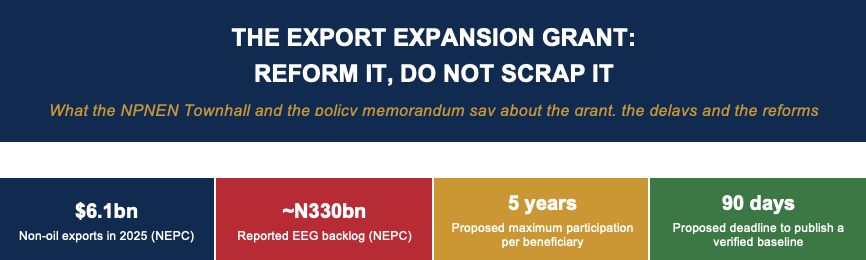
The loudest complaint is delay. NEPC puts the backlog at about N330 billion: N269.45 billion in verified claims from 195 companies and N60.64 billion in stepped-down claims from 32 companies for 2017 to 2020. At the Townhall, Mr Boyede described claims from several export years waiting at different stages, with approvals associated with 2020 to 2022 and formal approval still needed for later years. Dr Akanji argued that government should reconcile and verify the claims and settle them in a way that reflects present value, rather than treating delay as costless. Exporter Lanre Nwako made a practical point: banks and the Central Bank already hold detailed records of every shipment and repatriation, because they chase exporters when proceeds are late, so repeated verification before payment is hard to justify. She had shipped at least four containers a month for years and, she said, received no meaningful incentive. The Townhall also noted that NEPC was invited but did not send anyone.
| DOES IT WORK? THE QUESTION OF IMPACT |
Does the grant work? The honest answer is that nobody can yet prove it. NEPC reports that non-oil exports reached about 6.1 billion dollars in 2025, but Mr Boyede cautioned that rising exports do not show that incentives caused the rise. Exporters often supply their own power, water and access roads, and some firms keep exporting because of established customers, retained earnings or strong products even when payments are late. His memorandum adds that this must not be read as proof that the grant is unnecessary or that delay is harmless, since uncertainty hurts investment, working capital and smaller exporters most. The moderator added that commodity prices and new industrial output such as fertiliser may be driving the headline figures. The remedy is an independent impact assessment that compares beneficiaries with non-beneficiaries and reports jobs, value addition, new markets and additional export earnings for each naira of support.
| THE REFORM AGENDA |
The memorandum’s reform agenda is the most concrete part of the debate, and it is presented as policy proposals, not existing law. It proposes a maximum participation period of five years for each beneficiary from its first payment under the reformed scheme, with no automatic renewal and a narrow, published transition. It calls for graduated rates reflecting firm size, incremental export growth, domestic value addition, local sourcing, employment and market diversification, a ceiling or declining benefit for very large corporate groups, and a protected allocation for small and emerging exporters. It notes the industry-side concern that a few very large firms may take more than 60 percent of benefits, but stresses that this is unverified and must be tested against official beneficiary data. On legacy claims, it asks for an independent reconciliation, a realistic settlement schedule and a rule that no new approvals may exceed an authorised and funded envelope. On administration, it recommends a single application pathway, published timelines, status tracking, written reasons for rejection, an appeal route and risk-based verification, all running on a digital workflow linked to e-Form NXP and the national single window. The Trade Facilitation Fund, funded from Export Supervision Scheme collections, should have a published mandate, governance, funding sources and project criteria, and should not overlap with the EEG.
| A 12-MONTH ROADMAP |
Timing matters, and the memorandum sets a roadmap. Within 90 days, publish a verified baseline and reform principles. Within six months, complete legal, fiscal and stakeholder review and issue draft operational rules. Within 12 months, launch the reformed scheme with digital tracking, performance reporting and independent monitoring. It also calls for a legal review against domestic law and WTO and AfCFTA obligations and an update of the Export Incentives and Miscellaneous Provisions Act. The Townhall’s recommendations point the same way: reconcile claims by export year, publish reasons for any reduction or rejection, review rates against today’s costs, fund the EDF properly, and create a regular government and exporter consultation platform with a high-level coordination mechanism.
The EEG debate is not a choice between the old scheme and no scheme. As Dr Akanji put it, the call to rescue the grant should not mean business as usual. It should mean a smarter, predictable framework that pays on time and proves its returns in jobs, foreign exchange and productive capacity. Settle the past honestly, fund the future realistically, and reward the exporters who grow.