
For a crop that once made Nigeria Africa’s largest producer and the world’s second-largest exporter of ginger, after India, the past three years have been a case study in how quickly an agricultural export industry can unravel — and how hard it is to put back together. In July 2026, farmers in Kaduna State’s ginger belt began reporting dark leaf spots, yellowing and wilting on their farms again. It was a grimly familiar sight. The same symptoms, first noticed in Southern Kaduna in August 2023, went on to destroy between 80 and 90 percent of that year’s ginger crop, and in the worst-hit local government areas — Kachia, Kagarko and Jaba — losses reached 95 percent.
| THE PREVIOUS CRISIS: 2023 |
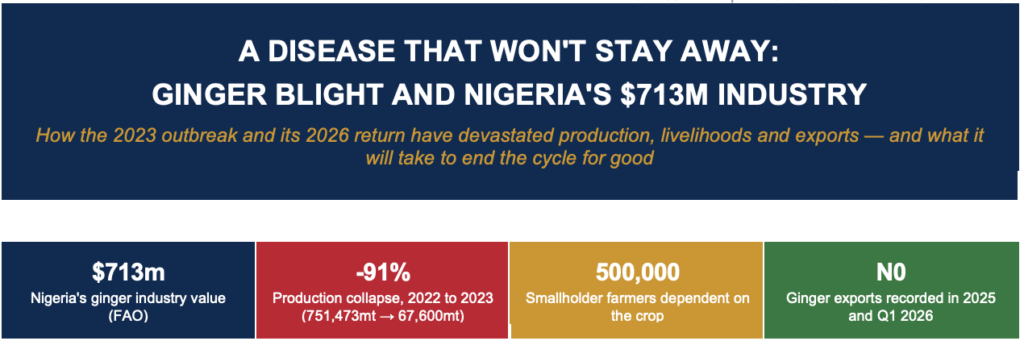
The 2023 outbreak was a slow-motion disaster made worse by a fast-moving pathogen. Farmers noticed wilting plants early in the season, but the fungal and bacterial pathogens behind it — consistent with Fusarium wilt and rhizome rot, and bacterial wilt caused by Ralstonia solanacearum, both soil- and seed-borne diseases well documented in ginger-growing regions worldwide — were not identified in time to contain them. By the time the Federal Government inaugurated a Ginger Blight Epidemic Control Taskforce and international partners like COLEAD were called in to help diagnose the problem, the damage was largely done. National production, which had stood at 751,473 metric tonnes in 2022, collapsed to just 67,600 metric tonnes in 2023 — a fall of over 90 percent. More than 100,000 farmers suffered severe financial setbacks, with losses estimated at ₦12 billion. Aggregators, transporters and exporters were hit alongside them, and many farmers who had taken loans to plant that season were left unable to repay them. Nigeria’s ginger export earnings, which had reached roughly ₦10 billion in a single quarter of 2023, cratered. Production recovered only partially in 2024, reaching 159,600 metric tonnes — still less than a quarter of pre-blight output.
| THE CURRENT CRISIS: 2026 |
Three years on, and just as the industry was beginning to rebuild, the disease is back. Farmers in Kagarko Local Government Area — in villages like Kurmin Dangana and Kubacha — say the outbreak has been spreading since early July 2026, with dark spots, yellowing leaves and rhizome rot appearing across multiple local government areas in Kaduna, which alone produces roughly 85 percent of Nigeria’s ginger. The timing is punishing: harvest normally begins in October and November, meaning the disease is striking at exactly the point where months of investment are about to turn into income. Farmers describe spending heavily on fungicides just to slow the spread, with some now spraying as often as once a week, and others resorting to premature harvesting simply to salvage something before their rhizomes rot in the ground. One farmer in Kubacha, still recovering from a ₦12 million loss in 2023, said he planted a smaller crop this year only to watch the blight reach his farm anyway.
The downstream effect on trade has been stark. According to National Bureau of Statistics data, Nigeria’s ginger exports fell from ₦26 billion in the fourth quarter of 2024 to just ₦5.3 billion in the second quarter of 2026 — and the country recorded zero ginger exports at all through 2025 and the first quarter of 2026. Scarcity has pushed domestic prices to levels that price Nigerian ginger out of its own export market: a metric tonne of fresh ginger now sells for roughly ₦5.2 million ($3,851), while dried split ginger fetches around ₦11.5 million ($8,518) per tonne — 184 percent above the international benchmark price of about $3,000 per tonne. At those prices, most exporters have simply stayed out of the market since 2023, ceding ground to India and China just as global demand for ginger is rising.
| LIVELIHOODS AND THE WIDER COST |
Behind the trade statistics is a livelihoods crisis. Ginger cultivation supports an estimated 500,000 smallholder farmers, concentrated in Southern Kaduna but extending into Plateau, Nasarawa and the Federal Capital Territory. For many of these households, ginger is not a side crop but the primary source of household income and loan repayment capacity; a second collapse in three years threatens to push families who had only just recovered from 2023 back into debt and food insecurity, and risks discouraging replanting altogether — the single worst outcome for an industry the government has explicitly named a foreign-exchange and diversification priority. FAO valued Nigeria’s ginger industry at $713 million (₦962.5 billion) even in its weakened state, underlining how much is still at stake.
The government has not been entirely passive. Beyond the 2024 taskforce, the National Agricultural Development Fund and the National Root Crops Research Institute in Umudike launched the Ginger Value Chain Recovery and Sustainability Programme in June 2026, distributing clean rhizomes and improved seed, alongside germplasm conservation and disease-free seed multiplication work, to roughly 6,000 farmers in Kaduna, Plateau and the FCT. NEPC-backed training on good agricultural practice, delivered with international partners, has also reached exporters and technical staff. But the return of the blight within weeks of that programme’s launch shows these interventions have not yet reached the scale, speed or permanence the problem demands.
Putting a permanent end to the cycle requires treating ginger blight as a structural risk to be managed continuously, not a one-off emergency to be responded to after the damage is done. That means, first, building a genuine certified clean-seed system at national scale: since the pathogens involved are soil- and seed-borne, contaminated rhizomes replanted season after season are the single biggest reason outbreaks recur, and NRCRI’s disease-free multiplication work needs to become the default seed source for every ginger-growing household, not a pilot reaching a few thousand farmers. Second, Nigeria needs a functioning early-warning and rapid-diagnosis system — mobile testing capacity and trained extension agents who can identify blight symptoms and alert authorities within days, not months, closing the exact gap that let the 2023 outbreak spread unchecked before anyone could name the pathogen. Third, quarantine and movement controls on rhizomes from affected local government areas are essential to stop the disease reaching Nasarawa and Plateau, as industry figures are already warning could happen. Fourth, crop rotation, soil sanitation and biological control methods — proven in other ginger-growing countries battling the same Fusarium and Ralstonia pathogens — should be built into standard extension advice rather than left to individual farmers to discover through costly trial and error. Finally, farmers need real financial protection: crop insurance or a dedicated recovery fund so that a disease outbreak does not automatically mean loan default and abandoned farms, which is what turns a plant disease into a permanent industry collapse. Nigeria has the land, the climate and the market position to remain a dominant global ginger supplier; what it has lacked, twice now, is the sustained institutional follow-through to keep one fungal disease from repeatedly wiping that advantage out.