
This month, at the 21st Abuja International Trade Fair, the Nigerian Ports Authority (NPA) said it is stepping up efforts to remove the bottlenecks hampering non-oil exports. Managing Director Abubakar Dantsoho pointed to two measures: dedicated Export Processing Terminals (EPTs), one-stop centres where sorting, packaging, quality certification and customs documentation are completed before cargo reaches the port terminals, and the Federal Government’s approval for the NPA to manage and develop Inland Dry Ports. The stated goal is stronger foreign exchange inflows. The announcement lands on a problem that exporters have already measured.
| WHAT EXPORTERS ARE SAYING: THE 3T IMPEX INDEX |
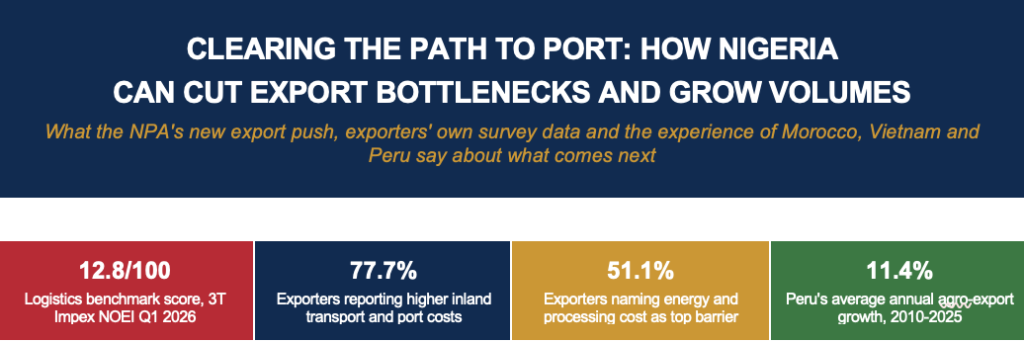
The 3T Impex Non-Oil Export Index for Q1 2026, a survey of 94 active exporters, scored 60.2 out of 100. Confidence is not the issue: business confidence scored 87.8, the outlook score exceeded 90, 91.5 percent of respondents expect international demand to improve, and 83 percent plan to expand capacity or warehouse space. The weak point is cost and friction. The logistics benchmark scored just 12.8 out of 100, with 77.7 percent of exporters reporting higher inland transport and port handling costs and only 3.2 percent reporting a fall. Regulatory efficiency (54.8) and financial health (52.7) were neutral, with 58.5 percent seeing no change in NXP or customs processing speed. Asked what blocks scaling, 51.1 percent named high energy and processing costs, 28.7 percent quality and standardisation rejections, and 16 percent difficulty finding international buyers. Demand is there. The cost curve and the paperwork are not.
| WHAT THE NPA PLAN GETS RIGHT, AND WHAT IT MUST PROVE |
Moving sorting, certification and documentation into one place attacks precisely the pre-port friction that exporters complain about, and Inland Dry Ports bring the port closer to producers in Kaduna, Kano, Abuja and Plateau, cutting trucking distance. Linking EPTs to Domestic Export Warehouses, in partnership with the Nigerian Export Promotion Council, also gives smaller exporters a structured route to the port. The caution is delivery. The EPT idea is not new: in 2022 the NPA said ten terminals had been licensed, with three about to come on stream, and expected Customs and the Standards Organisation of Nigeria to station export desks there. Reports on the latest announcement note that timelines, volume targets, locations and funding were not disclosed. A terminal without the regulators inside it is just another warehouse.
| LESSONS FROM AFRICA, ASIA AND SOUTH AMERICA |
Morocco shows what deliberate logistics can do for African trade. Tanger Med now connects to around 180 ports in 70 countries and runs a digital port community system, and Morocco’s exports to African markets reached about 32.7 billion dirhams in 2023, double the 2013 level. Yet Morocco’s own trade minister admitted a shortage of transport links to many African countries, which is why a new Agadir to Dakar sea route was being launched. The lesson: intra-African trade needs scheduled shipping lines, not just tariff preferences.
Vietnam’s goods exports reached a record 475 billion dollars in 2025, up 17 percent, built on a web of free trade agreements, including CPTPP, the EU deal and RCEP. By mid-2026, more than 1.2 million certificates of origin had been issued under these agreements, covering about 28 percent of export value, while industries invested in deep processing, traceability and environmental standards. The lesson: preferences only pay when exporters can prove origin and meet standards. A caution is that foreign-invested firms still dominate its electronics exports.
Peru’s agricultural exports grew by an average of 11.4 percent a year between 2010 and 2025, against 6.7 percent for Chile, and agriculture’s share of its GDP rose from 1.2 percent in 2000 to 4.3 percent in 2024. Its Agricultural Promotion Law cut the corporate tax rate to 15 percent, a national irrigation programme added hectares, and logistics upgrades included airports and the Chancay megaport. A free trade agreement made the United States its top fruit market. The lesson: a stable incentive regime sustained for years, matched with logistics, beats one-off campaigns.
| WHY AFRICAN MARKETS ARE THE QUICK WIN |
The African market is where these fixes pay off fastest. Nigeria’s Q2 2026 trade report shows Togo as its largest African destination and Ghana as its second, which tells us the regional trade corridors already exist, but also that much of the flow is informal or re-exported rather than documented trade. Shorter distances mean lower freight cost and shorter payment cycles, and AfCFTA tariff preferences favour processed goods with proper origin papers. A Nigerian cocoa grinder, cashew processor or manufacturer selling to Accra, Abidjan or Douala should be able to ship on a scheduled vessel, clear a single export terminal in a day or two, and carry certificates that the buyer’s customs accepts without argument. Today that experience is the exception rather than the norm.
| A FIVE-POINT PLAYBOOK |
Five moves would turn the NPA plan into volume, especially into African markets. First, make the EPTs real: publish which terminals are operating, station Customs, SON, NAFDAC and NAQS desks inside each, and commit to published processing times. Second, attack inland cost: pair Inland Dry Ports with rail, barge and e-call-up links, and tackle energy cost for processors, since over half of exporters name it as their biggest barrier. Third, open African sea lanes: scheduled coastal and short-sea services to Tema, Abidjan, Douala and Dakar, supported by the vessel incentives already discussed for public-private partnerships. Fourth, harmonise standards and documentation: use AfCFTA origin certificates, pursue mutual recognition of laboratory results with Ghana and Côte d’Ivoire, and help exporters pass first time, since 28.7 percent face quality rejections. Also track destinations honestly: Togo’s implausible rank as Nigeria’s largest export market signals re-export leakage that inflates the numbers. Fifth, finance and measure: extend pre-shipment finance to aggregators and processors, and track a quarterly logistics cost index with NEPC, NPA and exporters so the country can see whether costs are actually falling.
Nigeria’s exporters are confident and expanding, and the Peru and Vietnam experiences show that sustained, predictable support turns confidence into volume. The task for government and the NPA is to make the cost and speed of getting goods to port, and onto African ships, match that confidence. If the Export Processing Terminals and Inland Dry Ports deliver measurable reductions in clearance time and haulage cost, the next index should show the logistics score rising from its present level of 12.8 and non-oil volumes following.