
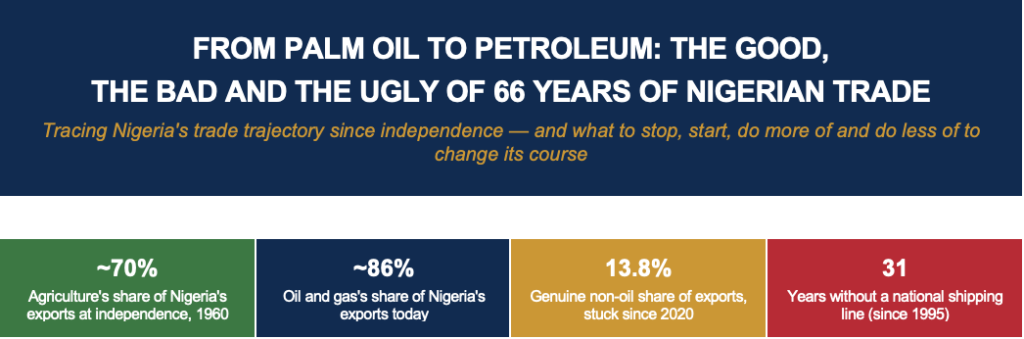
When Nigeria gained independence in 1960, it was one of the world’s genuinely diversified agricultural exporters — the largest exporter of palm oil on earth, the source of the famous groundnut pyramids of Kano, a major cocoa exporter through the Western Region’s cocoa houses, and a significant cotton and rubber producer besides. Agriculture accounted for roughly 70 percent of the country’s exports and the bulk of its foreign exchange earnings. Sixty-six years later, that picture has been almost entirely inverted: oil and gas now account for close to 86 percent of everything Nigeria sells abroad, and the crops that once made the country an agricultural export powerhouse have either collapsed or stagnated. Tracing that trajectory — and being honest about what in it was genuinely good, what was simply bad, and what remains outright ugly — is the necessary first step to charting a different one.
| THE GOOD |
Nigeria’s trade story is not one of unrelieved failure. The return to democracy in 1999 reopened policy space that decades of military rule had closed, and the 2005 Paris Club debt relief freed up fiscal room that eventually fed into infrastructure and reform spending. The most consequential recent good news is structural: the 2023 unification of Nigeria’s multiple exchange rates — painful as the transition was — removed a distortion that had quietly strangled non-oil exporters for years, since anyone earning dollars from cocoa or cashew was effectively taxed relative to those with access to preferential official rates. On the export-composition side, the ramp-up of the Dangote refinery and NLNG’s expanded capacity has, for the first time, allowed Nigeria to export refined petroleum products and gas rather than crude alone, capturing refining margin the country used to leave entirely to foreign buyers. And market access has genuinely improved: AGOA was renewed through 2028, AfCFTA is now in force, and a new mining framework signed with the United States in September 2026 opens fresh doors in a sector the government values at $700 billion. Access, in other words, has rarely been Nigeria’s binding constraint — capacity has, which is itself useful to know.
| THE BAD |
The bad news is that the underlying structure has barely moved in the direction repeated policy promises since the 1980s have claimed it would. Genuine non-oil exports — agriculture, solid minerals and manufacturing combined, excluding all petroleum and gas products — have oscillated in a narrow band of roughly 11 to 15 percent of total exports every year since 2020, with no sustained upward trend despite a continuous stream of National Export Promotion Council campaigns, diversification strategies and ministerial targets. The crops that built Nigeria’s original export economy have not merely stagnated; several have effectively disappeared from the export ledger. Nigeria was once the world’s largest palm oil exporter and is now a net importer of the same commodity. Groundnut exports from the old Northern pyramids are negligible today. Cocoa production has been overtaken many times over by Ivory Coast and Ghana. And Nigeria has had no national shipping line of its own since the Nigerian National Shipping Line collapsed in 1995 — 31 years during which the country has depended entirely on foreign carriers to move its own trade, forfeiting an estimated $6 billion a year in freight earnings it could otherwise capture.
| THE UGLY |
The ugliest parts of the trajectory are the ones Nigeria has been least willing to confront directly. Decades of oil windfalls were spent overwhelmingly on consumption and imports rather than reinvested in the agricultural and industrial base that oil money displaced — a textbook case of Dutch Disease that successive governments diagnosed correctly and treated barely at all. Porous land borders have made smuggling and re-export leakage a structural feature of Nigerian trade rather than an occasional aberration: recent trade data shows Togo recorded as Nigeria’s single largest export destination in the world, a scale of “consumption” not remotely plausible for a country of nine million people, and a clear sign that a meaningful share of what gets counted as Nigerian export growth is actually goods leaking out for re-export or smuggling rather than genuine foreign demand. And policy itself has been unstable to the point of self-sabotage: sudden border closures, on-and-off foreign exchange restriction lists, and diversification strategies that rarely survive a change of minister have repeatedly reset exporter confidence and planning horizons just as momentum was building, most visibly when the 2023 ginger blight wiped out an industry recovering from an almost identical shock only three years later.
None of this is a case for pessimism so much as for precision about what has actually been tried and what genuinely has not. The pattern across six decades is consistent: whenever Nigeria has built real productive or logistical capacity — as it is now doing with refining — the trade data has moved, and whenever it has relied on campaigns, targets and access agreements alone, the numbers have stayed exactly where they started.
| WHAT TO STOP, START, DO MORE OF AND DO LESS OF |
| STOP | Treating non-oil export promotion as a communications exercise — taskforces, launches and targets repeated by every administration without fixing the underlying financing, processing and logistics constraints that actually stop exporters from scaling. |
| START | Mandatory, legislated local value-addition across every major non-oil commodity — extending the “no raw export without processing” rule already applied to lithium to cocoa, cashew, sesame, palm produce and other solid minerals — backed by a national shipping and logistics capacity Nigeria has lacked since 1995. |
| DO MORE | Convert existing preferential market access (AGOA, AfCFTA, the EU, and now the US minerals framework) into actual shipped volume, and invest in agricultural research and disease resilience so supply shocks like the ginger blight don’t keep resetting hard-won export gains to zero. |
| DO LESS | Reactive, ad-hoc policy-making — sudden border closures, FX restriction lists and one-off interventions that whipsaw exporters’ planning horizons — and less tolerance for the unmonitored land-border leakage that distorts Nigeria’s own trade statistics. |