
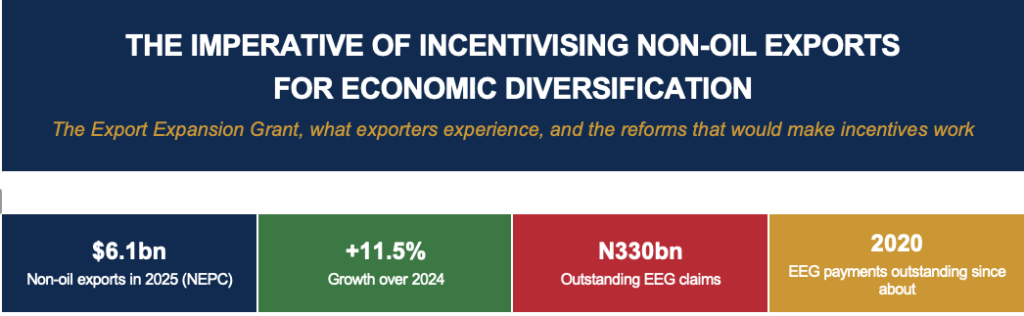
Nigeria earns most of its foreign exchange from one commodity, and that is why every shock to the oil price becomes a shock to the economy. Non-oil exports are the way out. They reached about 6.1 billion dollars in 2025, up 11.5 percent from 5.46 billion in 2024, according to the Nigerian Export Promotion Council (NEPC), with more than 8 million tonnes of goods in 281 product lines shipped to 120 countries. That is real progress. But it is a modest base for an economy that wants to be a trillion-dollar one, and it leans heavily on a few commodities: cocoa beans alone earned about 1.99 billion dollars and urea about 1.29 billion. Diversification will not arrive by itself. Governments everywhere pay exporters to take the risk of competing abroad, and Nigeria must do the same, but with an incentive system that actually works.
| WHY INCENTIVES MATTER |
The case for incentives is simple. Exporters face costs that their foreign competitors do not: unreliable power, expensive logistics, high-cost finance, multiple levies and long certification delays. An incentive offsets part of that gap and rewards the firms that bring in foreign currency. Nigeria’s toolbox has several parts. The Export Development Fund, run by NEPC, supports new exporters with training, trade-fair participation and logistics. The 1986 Export Incentives and Miscellaneous Provisions Act created the Export Adjustment Scheme Fund alongside the Export Expansion Grant. Duty drawback, tax exemptions, export processing zones and export-finance facilities from the Nexim Bank and the Central Bank complete the picture. The centrepiece has always been the Export Expansion Grant (EEG), a post-shipment reward paid, in its classic form, at 10 to 30 percent of the free-on-board value of confirmed exports whose proceeds have been repatriated.
| THE EXPORT EXPANSION GRANT: HISTORY AND BACKLOG |
The EEG’s history explains its troubles. Before 1999 it was paid in cash. After that it was issued as Negotiable Duty Credit Certificates that exporters could use to settle duties, pledge to banks or transfer. The scheme was redesigned in 2005 and 2013 and, by one count, suspended and revived eight times between 2005 and 2013, before being suspended in 2013 amid allegations of abuse. When Customs stopped honouring the certificates, banks that had accepted them as security were left with bad loans. Exporters now receive Export Credit Certificates that offset specified federal tax obligations, but the real problem is the queue. In September 2026 the Minister of Industry, Trade and Investment, Dr Jumoke Oduwole, said payments have been outstanding since about 2020, that the scheme is too costly, has no closing date and encourages raw-material exports. NEPC puts the backlog at about N330.08 billion: N269.45 billion in verified claims from 195 companies under a promissory note programme approved by the Federal Executive Council in May 2023, and N60.64 billion in stepped-down claims from 32 companies for 2017 to 2020.
So how effective has it been? Honestly, it is hard to credit the grant for the recent rise in exports when most of the money has not been paid. The growth in 2025 appears to owe more to commodity prices, the weaker naira and exporter effort than to incentives, and the grant’s reputation has suffered. An incentive that arrives six years late is not an incentive. It is an unsecured loan to government, and small exporters, who cannot carry such a receivable, are the ones who lose most. Large firms can wait, discount their certificates or lobby. A cashew or sesame exporter with a single container cannot.
| WHAT EXPORTERS EXPERIENCE |
Exporters report a consistent list of problems. Payments are slow and unpredictable. Verification passes through many hands, including NEPC, Customs, the Federal Ministry of Finance, the Central Bank, the Debt Management Office, the Accountant-General and the National Assembly, which must approve payments before promissory notes can be issued. Documentation is heavy, and rules have changed repeatedly, so planning is hard. Certificates were not always accepted as promised, as the Customs episode showed. Small and medium-sized exporters also lack information, cannot afford the intermediaries who prepare claims, and have no cash buffer. Even a perfect incentive cannot offset other constraints: electricity, logistics, certification delays and costly finance, which an analyst recently described as limiting the real value of the grant.
| REFORM UNDER WAY, AND WHAT MUST FOLLOW |
Reform is now under way. The government says it will clear the arrears and restructure the scheme. The President has approved ring-fencing 40 percent of monthly collections under the Nigerian Export Supervision Scheme for an independently managed Trade Facilitation Fund. The reformed scheme is meant to favour value-added and finished goods and to back emerging sectors. These are the right instincts, but design decides everything. Paying old claims without fixing the causes would only delay the next crisis.
Seven reforms would make incentives work. First, publish the arrears ledger, audit it, and pay in transparent tranches, with the smallest claims first so SMEs are relieved early. Second, give the Trade Facilitation Fund written rules on collections, allocations and disbursements, an independent board and a yearly public impact report. Third, make the incentive rules-based and automatic: calculate it from export data already captured through e-Form NXP and the National Single Window, credit it to an exporter’s online account within a fixed period, and let exporters track each claim from submission to settlement. India’s RoDTEP scheme shows the idea: the claim is declared on the shipping bill, Customs verifies it, and a transferable electronic credit is issued, with no minimum turnover threshold. Fourth, reward outcomes, such as value addition, local content, jobs and new markets, and set a sunset date and an annual budget cap so the scheme is affordable. Fifth, create an SME window with simplified claims, cluster or cooperative filing and a fast-track for small amounts. Sixth, make certificates and promissory notes bankable, so a financial institution can discount them at a known rate. Seventh, pair cash incentives with the things money alone cannot buy: dependable power in export clusters, export-lane priority at ports, faster certification and affordable trade finance.
| CONCLUSION |
Incentivising non-oil exports is not charity. It is the cheapest way for Nigeria to buy foreign exchange, jobs and resilience. The Export Expansion Grant failed not because the idea is wrong but because delivery was unreliable. Make it predictable, digital, outcome-based and open to small exporters, and it can turn diversification from a speech into a balance-sheet fact.