
Every serious exporting nation pays for exports in some way, directly or indirectly, because exporting costs more than selling at home: longer credit cycles, foreign standards, freight, and the risk of non-payment. The WTO bans most cash export subsidies on manufactured goods, so countries have moved toward refunds of taxes, duty relief, credit and insurance, and special zones. The evidence from those countries points to one lesson. The size of an incentive matters, but design and delivery matter more. An exporter will respond to a scheme that pays predictably and automatically, and will ignore one that pays late or not at all. That is the test Nigeria’s Export Expansion Grant (EEG) must now meet.
| FIVE TYPES OF INCENTIVE |
Five types of incentive appear across the countries reviewed. First, tax rebates, where the exporter recovers VAT or other domestic taxes embedded in the product. Second, duty relief, through drawback or duty-free imports of inputs. Third, post-shipment grants or credits, which pay on proven exports; the EEG belongs here. Fourth, export finance and insurance from credit agencies. Fifth, export processing zones with tax holidays and duty exemptions. Non-fiscal support such as trade fairs and market access sits beside all five.
| CHINA: THE REBATE AND ITS MEASURED EFFECT |
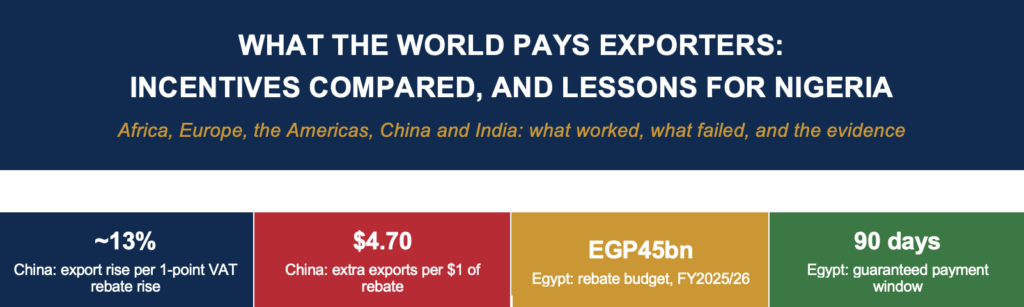
China is the clearest case of a rebate producing measurable results. Chandra and Long (2013) studied firm-level data for 2000 to 2006 and used a 2004 policy change to isolate the effect. They found that each one-percentage-point rise in the VAT rebate rate raised a firm’s exports by about 13 percent, and that each dollar of rebate paid was associated with roughly 4.70 dollars of extra exports. The rebate works because it is a rule: the rate is published by product, the exporter claims it, and the money returns through the tax system. China also adjusted rates by sector as policy changed, which shows the tool can be tuned, though it also created uncertainty.
| INDIA: DUTY RELIEF AND RODTEP |
India layers several instruments. Duty drawback and Advance Authorisation let exporters bring in inputs free of duty. The Remission of Duties and Taxes on Exported Products (RoDTEP), in operation since January 2021, refunds embedded taxes that other schemes miss, such as fuel VAT, mandi tax and electricity duty. The refund is a set percentage of export value, issued as a transferable e-scrip held in an electronic ledger. Cumulative disbursements passed Rs 57,976 crore by March 2025, and the 2025/26 allocation was Rs 18,233 crore. India’s merchandise and services exports in 2025/26 were estimated at about 860 billion dollars. India’s own record also carries a warning. An independent review finds no official estimate of how much RoDTEP raised exports, and notes that frequent mid-year rate changes, including a cut to half rates in February 2026 reversed a month later, make planning difficult. Payment is not proof of impact, and India has not yet published the outcome data.
| AFRICA: EGYPT, MAURITIUS, ETHIOPIA |
Egypt offers the closest African parallel to Nigeria. Its rebate programme paid about EGP 70 billion to more than 2,800 companies between 2019 and 2024, but unpaid claims built up: EGP 60 billion is outstanding for shipments before July 2024. The government’s answer for 2025/26 is a budget of EGP 45 billion, almost double the EGP 23 billion of the previous year, allocated by formula: added value 50 percent, export growth 30 percent, production capacity 10 percent and employment 10 percent. It guarantees payment within 90 days, stopped deducting unpaid tax liabilities from payments, and will clear the old arrears half in cash over four years and half by offset against tax, customs and utility bills. Mauritius shows the zone model. Its export processing zone offered tax holidays and duty exemptions, with preferential access to European markets. Enterprises rose from 88 in 1977 to 591 later, the zone reached about 20 percent of total exports, and over about 25 years unemployment nearly disappeared and per capita income quadrupled. Ethiopia shows the failure case. A 2017 study found its export incentives too weak to motivate firms, little better than domestic investment incentives, and undermined by weak administration, poor coordination and rent-seeking.
| EUROPE: CREDIT GUARANTEES |
Germany shows how a rich exporter helps firms without cash grants. Its Hermes export credit guarantees protect exporters and banks against non-payment from manufacture until the last instalment. In 2022 the federal government guaranteed 20.2 billion euros of exports, about 83 percent of new cover going to emerging and developing economies. Exporters pay premiums that match the risk, and the scheme earned the government a profit of 413 million euros that year. Support is therefore financed by users, not drawn from the budget. The European Union also phased out agricultural export refunds under WTO rules, showing that the direct subsidy route is closing.
| THE AMERICAS: UNITED STATES, MEXICO, BRAZIL |
The United States relies on its Export-Import Bank. In fiscal 2025 it approved about 8.7 billion dollars of transactions, estimated to support about 10.1 billion dollars of exports. Small businesses took 87.7 percent of transactions by number but 19.4 percent by value. Its charter expires on 31 December 2026 unless Congress renews it, a reminder that even a mature agency depends on political commitment. Mexico’s IMMEX programme lets factories import inputs temporarily without duty for re-export. By 2014 it covered about 6,171 establishments and 2.46 million workers, and ranked second to crude oil as a source of foreign currency. Brazil combines drawback with Reintegra, a credit on export revenue, and press reports show exporters there have repeatedly had to adapt when Reintegra rates were cut or suspended, the same rate-instability problem seen in India.
| LESSONS FOR NIGERIA |
Four lessons follow for Nigeria. Pay automatically and on time: Egypt’s 90-day guarantee and China’s rebate rule both rest on predictability, while Nigeria’s reported backlog of about 330 billion naira does the opposite. Fund it before promising it: Egypt had to find EGP 60 billion for old claims. Match the incentive to the goal: formulas that reward added value and export growth, as Egypt’s does, serve diversification better than flat rates. And measure results: China’s rebate effect can be quantified, while India and Nigeria cannot yet show theirs. Credit insurance and zones deserve a bigger place in Nigeria’s mix, because they are paid for by exporters or by investors and do not depend on annual budgets. Small exporters need particular attention. Germany gives priority to small and medium-sized firms, and the American agency serves mostly small businesses by number of deals, so a protected SME window, as the EEG reform memorandum proposes, has international precedent. Finally, Nigeria should design within WTO limits, favouring rebates of taxes actually paid, duty relief, credit and zones over pure cash subsidies, which invite challenge.
Taken together, the cases show that incentives raise exports when they are large enough to matter, simple enough to claim and reliable enough to plan around. The countries that gained did not simply spend more. Nigeria already has the legal framework, the export documentation system and the agencies; what it needs is funding discipline, speed and published results. They made the benefit certain, simple and measurable. Nigeria should reform the EEG on those terms, not abandon it. Evidence quality varies in this comparison: the Chinese estimate comes from academic research, while several figures for other countries are official or press-reported and do not isolate the effect of incentives from other causes.