A critical analysis of global demand for cattle by-products, Nigeria’s export volumes, and the twin bottlenecks — runaway certification costs at home and an unearned animal-health label abroad — leaving hundreds of tonnes of crushed horn and hooves unsold.
By 3T Impex Trade Intelligence Unit · Lagos · July 2026
Nigeria is home to the fifth-largest cattle herd in Africa — about 20.9 million head — and a livestock economy valued at roughly ₦30 trillion. Every day, the abattoirs of Lagos, Kano and Ibadan generate a mountain of horns, hooves and bones that much of the world is eager to buy. Yet right now, exporters of crushed cow horn and hooves are sitting on hundreds of tonnes of unsold stock, locked in warehouses, unable to ship. The problem is not demand. It is a collision of runaway regulatory costs at home and a decades-old animal-health label abroad that Nigeria has never taken the steps to shed.
A world that wants what Nigeria discards
Cattle by-products are quietly one of the most globally traded outputs of the meat industry. In the United States, the by-products of a single cow — hide, tallow, bone, offal — are worth around US$167 a head, about 13% of the animal’s value, with the hide alone accounting for roughly half (USDA/industry estimates). The global market demand for cow bones and hones alone of over $210 million dollars. Beyond hides, the humble horn, hoof and bone feed several fast-growing markets:
- Organic fertiliser: horn-and-hoof meal and bone meal are prized high-nitrogen, slow-release inputs. The global blood-meal market alone was about US$2.55 billion in 2025 and is forecast to reach US$3.08 billion by 2030 (Mordor Intelligence), riding an organic-farming boom that expanded global organic farmland from 74.7 to 96.4 million hectares between 2020 and 2022.
- Gelatine, collagen and ossein: bones are the feedstock for gelatine and collagen used in food, pharmaceuticals, capsules, cosmetics and nutraceuticals.
- Handicraft and artisanal horn: cow horn is thermoplastic — it can be heated, shaped and polished into combs, buttons, cutlery handles, shoehorns, jewellery and drinking vessels. Tellingly, the long-established UK hornware maker Abbeyhorn sources the large horns of Nigeria’s free-range Ankole cattle specifically as a by-product of the Nigerian meat industry — a direct, standing line of European demand for Nigerian horn.
- Bone char and feed: bones are processed into bone char for water filtration and sugar refining and, where permitted, into feed-grade meals.
The buyers are concentrated in Asia for raw material and in Europe for finished craft and technical uses. China and Vietnam dominate demand for raw Nigerian bones and horn-cores; India, Germany and the United States also feature.
Nigeria’s volume: big in tonnes, tiny in value
Just how much does Nigeria sell? According to World Bank WITS / UN Comtrade data for 2021 (HS 050690 — bones and horn-cores), Nigeria exported 23,481 tonnes worth just US$690,100.
| Destination | Volume (kg) | Value (US$) | Unit value (US$/kg) |
| China | 1,666,090 | 467,030 | 0.28 |
| Vietnam | 21,589,000 | 151,010 | 0.007 |
| Germany | 106,280 | 34,160 | 0.32 |
| India | 34,300 | 28,250 | 0.82 |
| United States | 16,000 | 5,370 | 0.34 |
| TOTAL | 23,481,000 | 690,100 | ~0.03 |
Source: World Bank WITS / UN Comtrade, 2021 (HS 050690, bones and horn-cores).
Two things leap out. First, the destinations confirm that China and Vietnam are the anchor buyers, with Vietnam taking the overwhelming bulk of the tonnage. Second — and this is the heart of Nigeria’s problem — the average unit value is about US$0.03 per kilogram. Nigeria is exporting these by-products almost entirely in raw, unprocessed form, capturing a sliver of the value that processors abroad will add. Nigeria ships the raw horn; someone else makes the comb, the capsule, the fertiliser and the collagen. That is the opportunity cost in normal times. What is happening now is worse: even the raw trade is seizing up.
From ₦40,000 to ₦1.25 million: the certificate that broke the chain
Every consignment of animal parts requires a veterinary health certificate — a document signed by a registered, VCN-licensed veterinarian attesting that the consignment is free of infectious disease and meets the destination country’s import rules. This is normal and necessary. What is not normal is the cost.
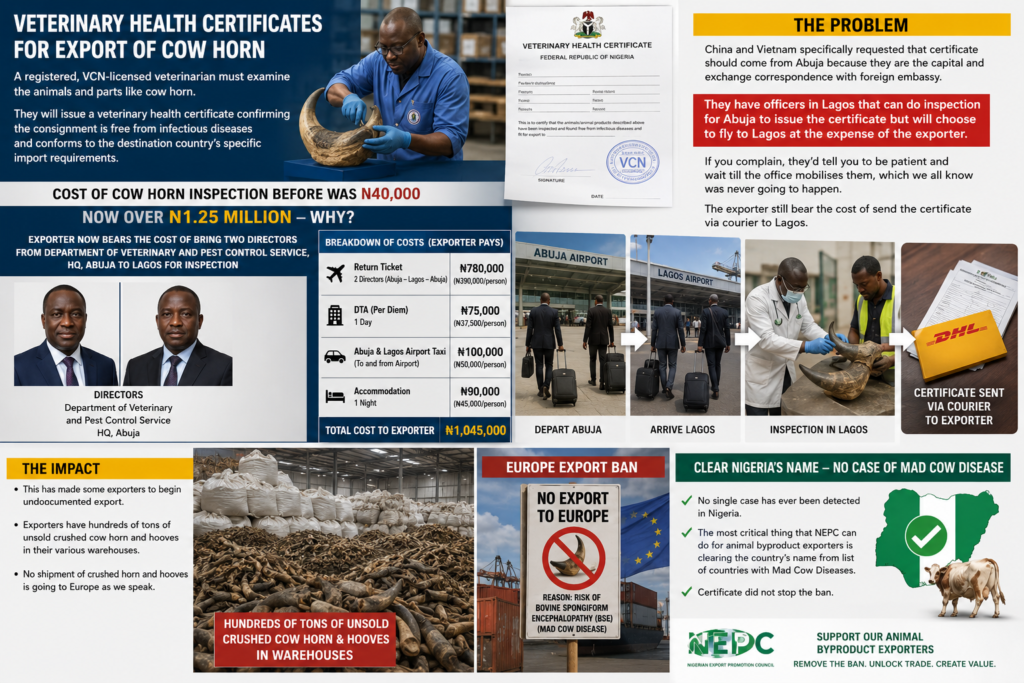
By exporters’ own account, the cost of cow-horn inspection has ballooned from about ₦40,000 to over ₦1.25 million per exercise. The reason has nothing to do with the science of inspection and everything to do with protocol and logistics. China and Vietnam now require that the certificate be issued from Abuja — the capital, which exchanges the diplomatic correspondence with their embassies. In response, rather than empower the veterinary officers already stationed in Lagos to inspect so that Abuja can issue the certificate, the Department of Veterinary and Pest Control Services flies two Directors from its Abuja headquarters to Lagos — and the exporter pays for the trip.
| Cost component (per inspection exercise) | Amount (₦) |
| Return airfare, 2 Directors, Abuja–Lagos (₦390,000 × 2) | 780,000 |
| Daily Travel Allowance (₦37,500 × 2, one day) | 75,000 |
| Airport taxi, Abuja & Lagos (₦50,000 × 2) | 100,000 |
| Accommodation (₦45,000 × 2, one night) | 90,000 |
| Sub-total (logistics only) | 1,045,000 |
| Plus statutory fee + courier of certificate to Lagos | additional |
| EFFECTIVE TOTAL (vs. ~₦40,000 when done by Lagos officers) | over 1,250,000 |
On top of the ₦1.045 million in logistics come the statutory fee and the cost of couriering the finished certificate back to Lagos — pushing the effective total past ₦1.25 million for an exercise Lagos officers once did for about ₦40,000. When exporters complain, they are told to “be patient and wait for the office to mobilise the officers” — a mobilisation that, in practice, never comes. The predictable result: some exporters have begun to bypass the system and ship undocumented — pushing legitimate trade into the shadows, starving government of data and revenue, and exposing exporters to seizure and reputational risk.
The phantom “mad cow”: a label Nigeria never earned
The second barrier is more consequential and more misunderstood. Exporters of crushed horn and hooves say they are blocked from Europe because Nigeria is treated as a mad-cow-disease risk — even though not a single case of classical bovine spongiform encephalopathy (BSE) has ever been confirmed in a Nigerian herd. They are right about the facts; but the label needs precise understanding, because that is where the solution lies.
The World Organisation for Animal Health (WOAH, formerly OIE) sorts countries into three BSE categories: negligible risk, controlled risk, and undetermined risk. Nigeria sits in “undetermined” — but not because mad cow disease was found here. A country lands in “undetermined” by default, whenever it has not submitted the risk-assessment and surveillance dossier WOAH requires to grant a cleaner status. Nigerian veterinary researchers have themselves documented that the country’s BSE risk “remains undetermined” precisely because of a lack of updated risk assessments and surveillance data — and it is that undetermined status which triggers the trade restrictions.
In other words, Nigeria is not on a list of countries that have mad cow disease; it is on a list of countries that have never done the paperwork to prove they don’t. The European Union, which only accepts animal by-products from approved third countries and establishments, treats that absence of proof as reason enough to keep the door shut. Germany appears among Nigeria’s 2021 buyers, but exporters report that shipments of crushed horn and hooves to Europe have since halted — and the veterinary certificate, however expensive, does not solve this, because the barrier is the country’s animal-health status, not the individual consignment’s paperwork.
What it costs Nigeria
- Lost foreign exchange and diversification: at the very moment Nigeria is banking on non-oil exports to earn hard currency, a ready, renewable, entirely non-oil stream is being throttled by self-inflicted cost and bureaucratic inertia.
- Stranded capital and deterred investment: exporters with warehouses full of unsellable stock cannot pay suppliers, banks or aggregators — and no rational investor will fund processing capacity while the export channel is this unreliable.
- A push into informality: when compliance costs thirty times what it used to and the ban blocks the premium market, undocumented export becomes a survival tactic — eroding the very data, revenue and traceability the government says it wants.
- Value-addition forgone: Nigeria’s US$0.03/kg raw exports are the mirror image of the jobs, factories and margin captured by processors abroad. Every tonne shipped raw — or not shipped at all — is Nigerian value left on the table.
The way forward
- Decentralise and digitise certification. Empower the VCN-licensed veterinary officers already in Lagos to inspect, and let Abuja issue the certificate on the strength of their report — or move to secure e-certification. No scientific reason requires two Directors to fly to Lagos, at an exporter’s expense, to see a horn a Lagos officer can see.
- Rationalise the fee. A transparent, published inspection tariff — closer to the old ₦40,000 order of magnitude than ₦1.25 million — would keep exporters inside the formal system.
- Pursue WOAH BSE risk status. NEPC should champion, and the Federal Ministry of Agriculture and Food Security and the Veterinary Authority should execute, a formal application for at least “controlled” and ideally “negligible” BSE risk recognition, backed by the surveillance WOAH specifies — followed by EU third-country/establishment listing.
- Move up the value chain. In parallel, Nigeria should stop exporting horn and bone as near-worthless raw commodity and support processing — horn and bone meal, ossein, gelatine precursors, polished horn craft — so the country captures dollars, not cents, per kilogram.
Conclusion
Nigeria has the herd, the raw material and a world of willing buyers. What it lacks is a certification regime that does not punish honesty and an animal-health status that reflects reality. Fix those two things — one an administrative decision, the other a dossier and some surveillance — and a subsector currently defined by warehouses full of unsold horn could become a quiet, steady earner of non-oil foreign exchange. Leave them unfixed, and Nigeria will keep exporting its cattle wealth as a raw afterthought, or not at all — while the combs, capsules and fertiliser the world makes from Nigerian horn are sold back to the continent that gave them away for three cents a kilo.