
Aliko Dangote could not find a single ship to move 1,000 tonnes of cement from Nigeria to neighbouring Ghana. Not a small operator’s cargo, not a boutique shipment — a rounding error for a company that produces 50 million metric tonnes of cement a year. That single fact, disclosed by Dangote Cement’s head of international trade export, Sada Ladan-Baki, at a non-oil export seminar in August 2026, captures the absurdity at the heart of Nigeria’s export logistics: the country’s biggest industrial exporter is reduced to trucking goods across land borders and absorbing punishing transit taxes — 18 percent VAT in Benin, again in Togo, again in Ivory Coast — because it cannot buy passage on a coastal vessel to a market a few hundred nautical miles away.
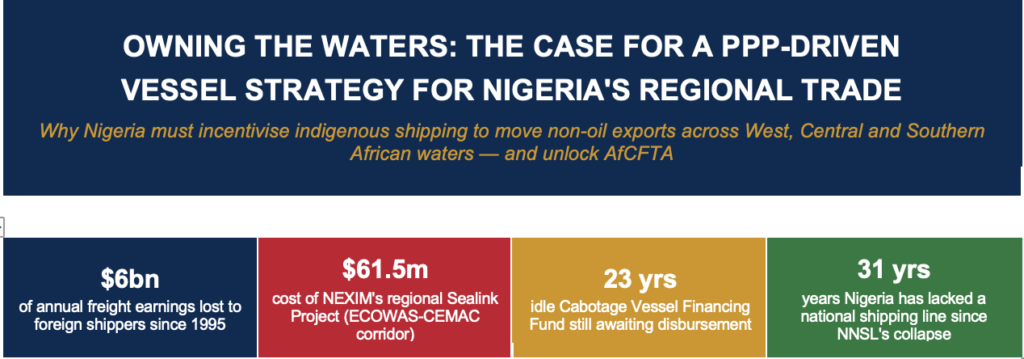
This is not a Dangote problem. It is a national one, and it is the clearest possible case for government-backed incentives to crowd in private capital through public-private partnerships (PPPs) for coastal and short-sea shipping across West, Central and Southern African waters. Since Nigeria’s National Shipping Line folded in 1995 after 36 years, the country has surrendered control of its own waterways, forfeiting an estimated $6 billion a year in freight earnings to foreign carriers. Nigeria produces the cargo — cement, fertiliser, sugar, agro-commodities, refined products — but rarely owns the ships that carry it, and almost never earns the freight margin that comes with owning them.
The corporate response so far has been self-help. BUA Group took delivery of two vessels in 2022 to move sugar to West African markets from its Rivers terminal. Dangote has built its own jetty at Lekki and owns terminals at Onne and Apapa, and is now weighing direct vessel acquisition. These are rational, defensive moves by companies with balance sheets large enough to absorb the capital cost. They are not, however, a market. A functioning regional shipping capacity that most non-oil exporters — including the small and mid-sized agro-processors and commodity aggregators who make up the bulk of Nigeria’s diversification push — can actually book space on requires something none of them can build alone: a pipeline of affordable, well-maintained tonnage, backed by financing structures that de-risk vessel ownership for Nigerian operators.
| THE CASE FOR A PPP-BACKED VESSEL INCENTIVE PROGRAMME |
The commercial logic for government intervention is not in dispute; the instrument to deliver it already exists, just unused. The Cabotage Vessel Financing Fund (CVFF), a $700 million pool built from a 2 percent surcharge on cabotage trade since 2003, was designed precisely to finance Nigerian-owned vessels. It sat idle for 23 years. An application portal opened in January 2026 with a promise of disbursement within 90 days; seven months later, shipowners were still waiting for their first payout. That delay is the single most damaging signal the government can send to an industry it is asking to invest hundreds of millions of dollars in steel that floats. Activating disbursement — with transparent, published criteria — is the first and cheapest incentive available, because the money has already been collected.
Beyond the CVFF, a genuine PPP framework should combine three things: blended concessional finance from development finance institutions (Afreximbank, the African Development Bank, and bilateral partners such as the European Union, which is already co-funding the NEXIM Sealink project) to lower the cost of capital on vessels that can run $10–$16 million apiece; risk-sharing instruments — partial credit guarantees and first-loss facilities — that let commercial banks lend against vessel assets without carrying the full default risk; and fiscal incentives, including import duty and VAT waivers on vessel acquisition, tax holidays for indigenous shipping lines building regional fleets, and cabotage law enforcement that reserves domestic coastal trade for Nigerian-flagged tonnage once that tonnage exists. Ladan-Baki’s call for commercial banks and Afreximbank to “take a leading role” in financing vessel acquisition is, in effect, a call for exactly this kind of blended structure.
| THE CHALLENGES — AND HOW TO OVERCOME THEM |
Four obstacles have repeatedly stalled Nigeria’s regional shipping ambitions. The first is financing access: vessels are expensive, collateral-poor assets in the eyes of Nigerian banks, and the CVFF’s own history shows that even a dedicated pool of capital can be trapped by bureaucratic and legal ambiguity over disbursement modalities. The fix is procedural discipline — a published, time-bound approval process, ring-fenced from budget-cycle politics, with development finance institutions co-guaranteeing early disbursements to build confidence.
The second is infrastructure: unsurveyed and unchanted inland and coastal channels, wrecks and silt in rivers such as the Niger, and moribund ports like Burutu that have not handled meaningful traffic since the 1970s. No investor releases a $10–$16 million vessel into uncharted water. This is squarely a public-goods problem, and it is the reason the EU and the Port of Antwerp-Bruges’ technical partnership on Burutu Port rehabilitation, and NEXIM’s charting of the lower River Niger with the Navy and NIWA, matter more than they might appear to at first glance — they are the precondition, not a footnote, to any PPP working.
The third is security: the Niger Delta corridor and the wider Gulf of Guinea remain a piracy and militancy risk zone that raises war-risk insurance premiums and deters underwriters and operators alike. The Nigerian Shippers’ Council has flagged this explicitly as a precondition for the Sealink project’s viability, alongside its call for a dedicated security architecture along that axis. Overcoming it requires sustained naval presence (NEXIM’s MoU with the Navy for charting, security and dockyard use is a step in that direction), regional information-sharing with Gulf of Guinea neighbours, and insurance pooling mechanisms that spread the premium burden across operators rather than pricing small players out entirely.
The fourth is regulatory fragmentation: the same VAT-stacking that punishes Dangote’s trucks at Benin, Togo and Ivory Coast borders will eventually punish coastal cargo too if port charges, cabotage rules and customs procedures are not harmonised across ECOWAS and CEMAC states. This is where AfCFTA’s institutional machinery — and Nigeria’s own trade diplomacy — has to do real work, converting tariff preferences on paper into predictable, harmonised port and transit costs on water.
| NEXIM’S SEALINK PROJECT: WHERE THINGS ACTUALLY STAND |
The nearest thing Nigeria has to a live answer to this problem is the NEXIM Sealink Project, a PPP promoted by the Nigerian Export-Import Bank together with the Federation of West African Chambers of Commerce and Industry (FEWACCI), NACCIMA and Cameroon’s Transimex S.A., structured through a Special Purpose Vehicle, the Sealink Promotional Company Limited. First conceived to establish dedicated ocean-going and inland vessels linking ECOWAS coastal ports with Central Africa’s CEMAC region, it carries a projected cost of $61.5 million, split roughly 40 percent private equity, 40 percent institutional debt and the remainder for SPV promotion, with Afreximbank and the African Development Bank confirming the project bankable after a funded feasibility study.
Progress has been real but slow. NEXIM and the Navy have charted the lower River Niger, private shipyards in Norway, Finland and China have expressed willingness to build barges locally, and as recently as June 2026 a NEXIM delegation — backed by European Union co-funding and technical support from the Port of Antwerp-Bruges — briefed the Nigerian Shippers’ Council on plans to rehabilitate and reopen Burutu Port as a core node of the corridor. Yet the project has missed multiple launch timelines since it was first announced, and the Shippers’ Council’s own June 2026 assessment was candid: the current fleet operating along the proposed corridors is inadequate for the project’s ambitions, dredging costs still need to be built into the financial model, and a clear dispute-resolution framework must be in place before any concession is signed. Sealink remains, in other words, the right architecture — SPV, blended finance, multilateral technical support — still waiting for the vessels, the dredged channels and the disbursed capital to catch up with the paperwork.
Smaller private players are not waiting. Indigenous marine logistics firm Starzs Investments, marking 40 years in the water in 2026, operates 11 vessels, has applied to the newly activated CVFF, and is investing in new tugboats while eyeing Pan-African expansion. SIFAX Group opened 2026 with an explicit strategy to expand shipping and inland container operations across West Africa, including new direct export routes. These are proof points that indigenous capacity can be built — but at a scale still far too small to absorb Nigeria’s non-oil export ambitions, and each is financing growth largely on its own balance sheet in the absence of the cheaper, patient capital a properly functioning PPP framework would supply.
| WHY THIS IS AN AfCFTA IMPERATIVE, NOT JUST A LOGISTICS FIX |
The African Continental Free Trade Area promises tariff-free access across a market of 1.3 billion people, but a tariff preference is worthless to an exporter who cannot physically move goods to the market that grants it. Intra-African trade remains stuck at roughly 15–18 percent of the continent’s total trade, far below other regions, and shipping capacity — not tariffs — is now the binding constraint for bulky, non-oil cargo of exactly the kind Nigeria is trying to grow: cement, fertiliser, processed agro-commodities. A Nigerian PPP vessel-financing programme, anchored to Sealink and open to indigenous operators like Starzs and SIFAX, is therefore not a maritime-sector side project. It is the physical infrastructure AfCFTA needs to become real for Nigerian exporters, and the surest way for Nigeria to convert its position as the continent’s largest economy into the continent’s leading trade and transshipment hub, rather than watching that freight — and the $6 billion a year that comes with it — continue to flow to foreign shippers.