
For decades, Nigeria’s export identity has been written almost entirely in barrels, bags and tonnes — crude oil, cocoa, cassava, cement. Late in August 2026, the Federal Government signalled that this identity is finally being rewritten to include a fourth column: talent. The ‘Hire from Nigeria’ campaign, launched in Abuja by the Minister of Information and National Orientation, Mohammed Idris, alongside the Minister of Industry, Trade and Investment, Dr Jumoke Oduwole, is a deliberate attempt to turn Nigerian professional and digital skills into a foreign exchange earner in their own right — without a single person having to relocate abroad to earn it.
This is not a vanity initiative. It is a response to a structural shift in global trade that Nigeria has, until now, largely watched from the sidelines. World services exports crossed $9.5 trillion in 2025, growing 8 percent for the year, with ‘other business services’ — the digitally tradable, knowledge-intensive category that includes IT, back-office processing, consulting, design and professional services — growing 10 percent globally and even faster across Africa, at 13 to 14 percent. Services, unlike commodities, do not require a ship, a port or a customs post; they move on fibre-optic cable, and the country that builds the skills, the standards and the marketing muscle to sell them captures foreign exchange with almost none of the logistics burden that chokes Nigeria’s goods exports.
To understand where Nigeria fits, it helps to separate services exports into their broad categories. Trade economists typically group them by how the service is delivered: cross-border supply, where the service itself crosses the border while the provider stays put (software development, call-centre and BPO work, remote accounting, engineering design, content moderation, animation); consumption abroad, where the customer travels to consume the service (tourism, medical tourism, education of foreign students); commercial presence, where a company sets up a local subsidiary abroad to deliver a service (banking, insurance, logistics franchises); and movement of natural persons, where the professional physically travels to deliver a service temporarily (construction supervision, specialist medical missions, consulting engagements). Beyond these modes, sector categories worth naming separately include ICT and digital services, professional and business services (legal, accounting, consulting, engineering), creative and cultural exports (film, music, fashion, gaming), financial and insurance services, transport and logistics services, and travel and tourism receipts.
Nigeria is not equally competitive across all of these. It is, by the government’s own framing and by structural fact, best positioned in cross-border digital and business-process services — the category the ‘Hire from Nigeria’ campaign is explicitly targeting. The reasons are the ones Minister Idris and Dr Oduwole cited: a young population, with about 70 percent of Nigerians under 30 according to Education Minister Maruf Tunji Alausa; deep English-language proficiency; a time zone that overlaps conveniently with both Europe and much of Africa; a fast-growing technology ecosystem already producing globally recognised fintech and software talent; and an entrepreneurial culture used to building things without much institutional support. Unlike tourism or medical travel, which need airports, hotel capacity and visa regimes to scale, cross-border digital services need only a laptop, reliable power and internet, and a credible route to global clients — which is precisely the gap the campaign, and the accompanying National Outsourcing Policy due in November 2026, are meant to close.
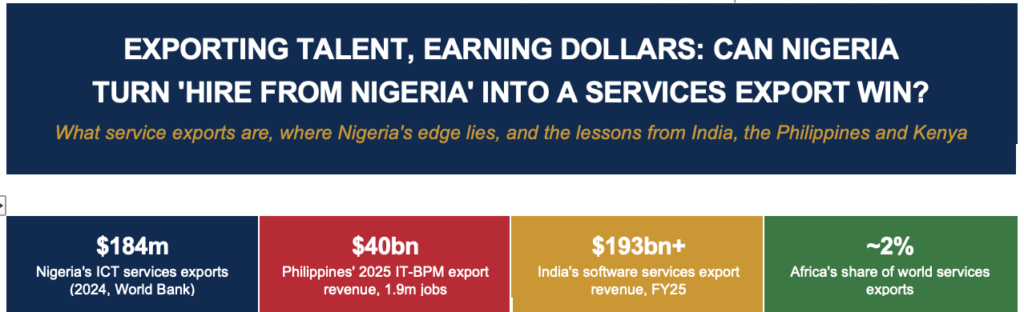
The current state of play, however, shows how much ground there is to cover. World Bank data puts Nigeria’s ICT service exports at just $184 million in 2024 — a rounding error against the sector’s potential, and historically only around 3 to 4 percent of Nigeria’s total services exports, which UNCTAD figures suggest have hovered in the low single-digit billions. That composition itself is telling: across Africa, services exports remain dominated by travel receipts, which account for roughly 42 percent of the continent’s total, while high-knowledge-intensive categories like IT and financial services make up only about 20 percent — leaving, as UNCTAD has put it, ‘immense room for growth.’ Zoom out further and the picture sharpens: Africa as a whole captures only around 2 percent of world services exports, even though the continent recorded the fastest regional growth rate for services exports of anywhere in the world in 2025. Nigeria, Africa’s largest economy and most populous nation, is not yet capturing a share of that growth remotely proportionate to its talent base.
Other developing countries have already proven the model Nigeria is now attempting. India built the template: a national IT and software policy dating to the 1990s, tax holidays and export-processing zones for IT companies (the Software Technology Parks scheme), sustained investment in English-medium technical education, and government-industry bodies like NASSCOM that marketed ‘Brand India’ globally while enforcing delivery and quality standards. The result is a sector exporting more than $193 billion in software and IT services alone in FY2025, employing millions and accounting for a meaningful share of GDP. The Philippines took a similar path more recently, using its Philippine Economic Zone Authority to offer fiscal incentives to BPO investors, pairing that with an industry association (IBPAP) that coordinated workforce training and global marketing; its IT-BPM sector now earns roughly $40 billion a year in export revenue and employs 1.9 million people, deliberately climbing from voice-based call-centre work into higher-value software, finance and healthcare information services. Closer to home, Kenya has run the smallest but most instructive version of this playbook: its Ajira Digital programme trains young people in digital and freelance skills, its Export Processing Zones offer BPO-specific incentives, and initiatives like the recently launched Outsourcing Alliance coordinate government, industry and global clients under Kenya’s Digital Economy Blueprint — building a sector still modest in dollar terms but growing quickly and consistently marketed as a serious alternative outsourcing destination.
The common thread across all three is that none of them treated talent export as a communications campaign alone. Each paired workforce development with fiscal incentives, built a coordinating institution to hold quality and delivery standards, and invested consistently in global marketing over many years rather than a single launch event. For ‘Hire from Nigeria’ to succeed on that scale, the pieces already announced need to function as a system rather than parallel efforts: the National Talent Accelerator Network must genuinely build talent pipelines against real global demand; the forthcoming national outsourcing policy needs teeth on quality certification and dispute resolution so international employers trust Nigerian delivery; the Ministries of Education, Labour, Foreign Affairs and Information must sustain their ‘all-of-government’ coordination well past the UN General Assembly launch; and private partners such as Tech4Dev, iDICE and the Mastercard Foundation need scaled, multi-year funding rather than pilot-stage support. Done well, this could be the export vertical that finally lets Nigeria earn foreign exchange from its greatest and least-monetised resource — its people — without demanding that they leave home to do it.