
On 1 September 2026, the US House of Representatives voted 370 to 48 to extend the African Growth and Opportunity Act (AGOA) through 31 December 2028, mirroring a Senate vote passed weeks earlier. The measure, folded into a short-term Continuing Resolution funding the US government, now awaits the President’s signature. For Nigeria and 31 other sub-Saharan African beneficiary countries, the extension removes an immediate cliff-edge: AGOA had already lapsed once, on 30 September 2025, throwing exporters into months of uncertainty before Congress restored it retroactively. The renewal buys time. Whether Nigeria uses that time to finally build a non-oil export industry to the United States, rather than simply breathing a sigh of relief, is now the only question that matters.
AGOA has been in force for a quarter of a century. Congress created it in 2000 to give eligible sub-Saharan African countries duty-free access to the US market for more than 1,800 product lines, provided they meet governance criteria — progress toward a market-based economy, the rule of law, political pluralism and due process. Countries that fall short can be stripped of eligibility, as Gabon, Niger, the Central African Republic and Uganda were in January 2024. The programme has never offered reciprocal access to African markets in return, which is precisely why American manufacturers have periodically questioned its value, and why its renewal has grown more contested with each cycle: an initial push for a three-year extension in January 2026 stalled, before the current two-year compromise emerged attached to a funding bill, with no substantive reform of a programme that US business groups themselves describe as designed for a goods-centric economy that increasingly overlooks services and digital trade.
| WHY NIGERIA’S NON-OIL EXPORTS TO THE US STAYED SO SMALL |
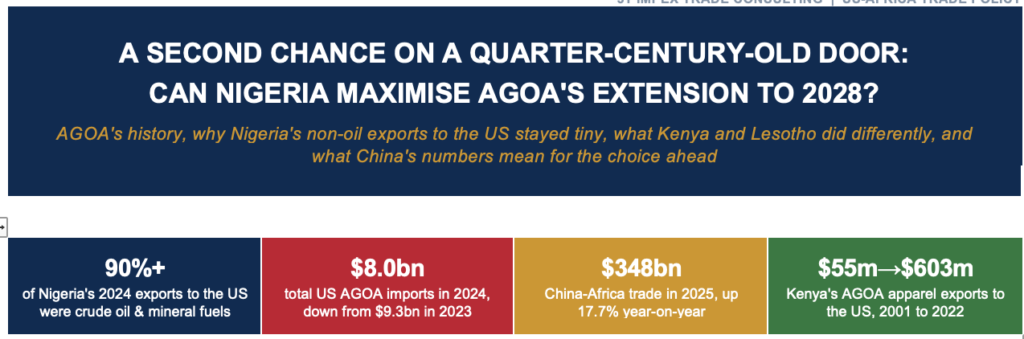
Nigeria has been an AGOA beneficiary for the entire 25-year life of the programme, and has almost nothing structurally diversified to show for it. In 2024, Nigeria’s total exports to the United States came to roughly $3.8 billion, and by the trade minister Jumoke Oduwole’s own account, over 90 percent of that consisted of crude petroleum, mineral fuels, oil and gas. Nigeria was, in fact, AGOA’s single largest crude oil exporter in 2024, at $1.6 billion. Everything else — fertiliser and urea, lead products, live plants, flour, nuts, raw cocoa and cocoa preparations, plastics and rubber — made up a rounding error by comparison, together accounting for perhaps 5 to 8 percent of export value. Nigeria’s exports to the US actually peaked at $7.1 billion in 2017, almost entirely on the strength of a crude oil rebound, not a manufacturing breakthrough.
The reason is structural, not accidental. AGOA’s tariff preference only matters if a country has manufacturing capacity ready to use it — factories, export processing zones, reliable power, port efficiency, and firms that meet the programme’s specific rules of origin. Nigeria spent the AGOA era focused on an oil sector that needed no such preference to reach the US market (crude already enters duty-free under standard trade rules), while its light-manufacturing and agro-processing base remained undercapitalised, power-constrained and logistically expensive to export from — the same shipping and infrastructure gaps that still constrain Nigerian non-oil exporters across every market, not only the US. Preferential access without production capacity is a door left open to an empty room.
| WHAT OTHER AFRICAN COUNTRIES DID DIFFERENTLY |
The countries that actually built non-oil export industries under AGOA all made the same core choice: they treated the preference as a reason to build a specific, investable industrial base, not merely a discount to advertise. Kenya is the clearest case. It became the first country to satisfy AGOA’s additional apparel-sector requirements, giving it a head start that attracted global garment manufacturers years before competitors could qualify. It backed that first-mover advantage with dedicated Export Processing Zones offering reliable infrastructure and streamlined customs, and the results compounded for two decades: Kenyan apparel exports to the US grew from $55 million in 2001 to $603 million in 2022, now representing nearly 68 percent of its total US exports, over 60,000 direct jobs and more than $700 million in cumulative investment.
Lesotho ran a similar playbook at even greater intensity, leveraging duty-free access to become one of Sub-Saharan Africa’s largest apparel exporters, with textiles reaching close to 20 percent of GDP by 2020 — though its extreme dependence on a single product and single market also meant that when AGOA briefly lapsed in 2025, factories shut down and the government had to declare a national state of disaster, a caution against replicating the model without diversifying beyond it. Ethiopia built purpose-designed industrial parks, including the Hawassa Industrial Park, specifically to attract garment manufacturers under AGOA and other trade preferences. Madagascar and Mauritius built textile capacity that pre-dated AGOA under earlier European preference schemes and simply redirected it toward the American market once AGOA opened. In every successful case, government-backed industrial infrastructure came first, tariff preference second — the opposite of Nigeria’s sequence, where preference sat unused for a quarter century awaiting an industrial base that was never built to match it.
For Nigeria, maximising this fresh two-year window means moving with genuine urgency on the sectors where raw capacity already exists but processing does not: cotton, textiles and garments (reviving a textile sector that once employed over a million people); cocoa processing rather than raw bean export; leather and leather goods; and processed agro-commodities such as cashew, sesame and ginger. It means fast-tracking dedicated export processing zones with guaranteed power and streamlined single-window customs clearance — the same institutional gap NEXIM’s Sealink shipping project and the National Single Window platform are separately trying to close — and it means courting the same kind of anchor foreign manufacturing investment that gave Kenya and Ethiopia their initial scale. Two years is a short runway for factories that take years to build, which makes speed, not ambition, the binding constraint.
| WHAT THIS MEANS AGAINST CHINA’S GROWING FOOTPRINT |
AGOA’s renewal cannot be read in isolation from China’s parallel and much larger push into African trade. China-Africa trade hit a record $348 billion in 2025, up 17.7 percent year-on-year — more than 40 times the size of total US AGOA imports, which fell to just $8.0 billion in 2024. China has been expanding zero-tariff access for African goods since December 2024, initially for 33 least-developed countries, then from May 2026 extending preferential, though not identical, zero-tariff treatment to twenty better-off economies including Nigeria, Kenya, Egypt and South Africa. The contrast in trajectory is stark: AGOA was allowed to lapse once already and was extended this time only as an attachment to an unrelated funding bill, with no reform and continued annual uncertainty about its future; China’s tariff opening is expanding in scope and being formalised into longer-term bilateral economic partnership agreements.
Yet China’s numbers carry their own warning for Nigeria. Even as China’s imports from Africa rose to $123 billion in 2025, Chinese exports to Africa rose faster still, to $225 billion — leaving China with a $102 billion trade surplus against the continent, up 65 percent in a single year. China is not a substitute market offering Africa a better deal than the US; it is a second market with its own deepening imbalance, dominated by the same raw-commodity export pattern that has kept Nigeria’s AGOA utilisation so thin. The lesson for Nigeria is not to choose between Washington and Beijing, but to recognise that neither preference scheme will build an industrial base on its own. AGOA’s 2028 deadline and China’s own two-year non-LDC tariff window are both finite, both revocable, and both indifferent to whether Nigeria uses them. The only reliable asset is domestic processing capacity that can sell into any of these markets — American, Chinese, or the AfCFTA’s own 1.3-billion-person market — whichever preference happens to be open at the time.