
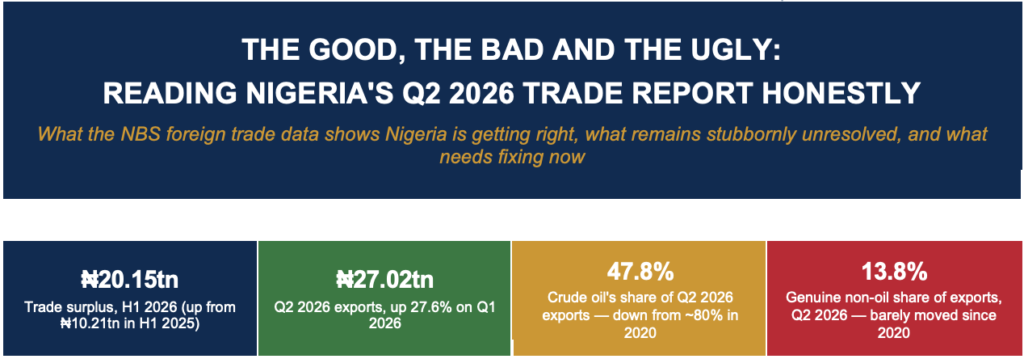
Nigeria’s Q2 2026 Foreign Trade in Goods report, released by the National Bureau of Statistics, tells a story with three distinct faces. Read one way, it is a genuine success story: a trade surplus that has nearly doubled year-on-year and an export sector finally showing the fruits of the Dangote refinery and NLNG ramp-up. Read another way, it is a familiar disappointment: the diversification Nigeria has chased for over a decade remains stubbornly out of reach. And read a third way, buried in the country-by-country detail, it reveals a distortion in the numbers themselves that deserves as much attention as the headline figures. Taken together, the report is less a verdict than a diagnosis — and a fairly precise one, if policymakers are willing to read past the good news.
| THE GOOD |
The topline numbers are genuinely strong. Nigeria’s trade surplus for the first half of 2026 stood at ₦20.15 trillion, nearly double the ₦10.21 trillion recorded over the same period in 2025. Total trade in the second quarter alone reached ₦41.44 trillion, with exports of ₦27.02 trillion rising 27.6 percent on the first quarter — a sharp quarter-on-quarter acceleration by any measure. Perhaps the single most encouraging shift in the entire report is structural: for the first time in the dataset, exports classified as ‘non-crude oil’ (₦14.11 trillion, or 52.2 percent of total exports) outweighed crude oil exports (₦12.91 trillion, 47.8 percent) in a quarter. Crude’s share of total exports has now fallen from roughly 80 percent in 2020 to under half. That shift is real, and it is largely the payoff of the Dangote refinery and NLNG train capacity coming fully online — Nigeria is now exporting kerosene, gas oil, natural gas and urea at meaningful volumes rather than shipping out crude alone. Regionally, Ghana has solidified its place as Nigeria’s second-largest African export destination and import source, a sign that West African trade corridors are deepening in ways that could eventually feed into AfCFTA-driven regional value chains.
| THE BAD |
Look past the crude-versus-non-crude reclassification, however, and the diversification story falls apart. The report’s own ‘Non-Oils Exports’ line — the genuine non-oil, non-gas figure covering agriculture, solid minerals and manufacturing — came in at just ₦3.73 trillion for Q2 2026, or 13.8 percent of total exports. That is barely different from the 11.4 percent recorded back in 2020, and it has oscillated in a narrow 7-to-19-percent band every quarter since, with no sustained upward trend despite six years of National Export Promotion Council campaigns, an entire non-oil export strategy, and repeated government pledges to hit double-digit billions in non-oil earnings. The product-level detail is even starker: Nigeria’s flagship non-oil exports — cashew nuts, cocoa beans and sesame seeds — together account for under 2 percent of the country’s total export value in the world product rankings. Meanwhile, the import side shows a country still dependent on the basics: motor spirit (petrol) is Nigeria’s single largest import product by value at ₦952 billion, durum wheat is third at ₦405 billion, and used vehicles and motorcycle CKD kits together add another ₦563 billion — a country importing fuel, bread and cars in bulk while its refining and manufacturing sectors are only beginning to scale.
| THE UGLY |
The most uncomfortable finding sits in the country rankings. Togo is listed as Nigeria’s single largest export destination in the entire world for Q2 2026 — ahead of India, the United States and every EU market — worth ₦1.498 trillion, of which ₦1.35 trillion is officially ‘non-crude oil.’ That figure, for a country of roughly nine million people, is simply not credible as genuine domestic Togolese consumption. It is the clearest available evidence of the long-documented Lomé-corridor pattern: goods, and especially refined fuel, flowing out through Togo (and to a lesser extent Benin and Cote d’Ivoire, both also inflated in the rankings) for onward smuggling, re-export, or informal re-entry into the Nigerian and regional market. This matters beyond curiosity — it means the very ‘non-crude oil export growth’ being celebrated in the Good section above is, to an unknown but likely significant degree, inflated by leakage rather than genuine foreign absorption of Nigerian products, and it represents real tariff and forex-tracking revenue that never gets properly accounted for. A second, smaller oddity: crude oil itself appears among Nigeria’s own top ten import products, worth ₦787 billion — a reminder that even Nigeria’s refining renaissance still depends on feedstock and grade-matching imports that blur the clean ‘exporter of crude, importer of everything else’ story the country likes to tell about itself.
What should Nigeria continue doing? Keep scaling refinery- and gas-linked export capacity — it is the one lever that has visibly moved the needle on export composition in six years, and there is more room to grow as Dangote’s refinery approaches full utilization and NLNG’s Train 7 ramps up. Keep deepening West African trading relationships with Ghana and Cote d’Ivoire, which show real, plausible two-way trade growth distinct from the Togo distortion.
What must be corrected immediately? First, the Customs Service, the Nigeria Export Promotion Council and the National Bureau of Statistics need a joint methodology review to flag and separately report transshipment-inflated destinations like Togo, so policymakers and the public are not misled by headline non-oil export numbers that are substantially re-export leakage rather than genuine market penetration. Second, the non-oil export strategy itself needs to shift from promotion to production: cashew, cocoa and sesame remain raw, unprocessed commodity exports capturing minimal value-add, and without serious investment in processing capacity, certification infrastructure and export finance, the 13-to-14-percent non-oil share will keep oscillating in the same band it has occupied since 2020. Third, the durum wheat and used-vehicle import bill points to two overdue policy pushes — a genuine local wheat substitution programme and incentives for local vehicle assembly — that would cut import dependency on both food security and manufacturing fronts simultaneously. The Q2 2026 numbers are not a failure. They are proof that when Nigeria builds real productive capacity, as it did with refining, the trade data moves. The task now is building that same capacity into cashew processing plants, cocoa grinding facilities and wheat farms — and cleaning up the statistics enough to see clearly whether it is working.