
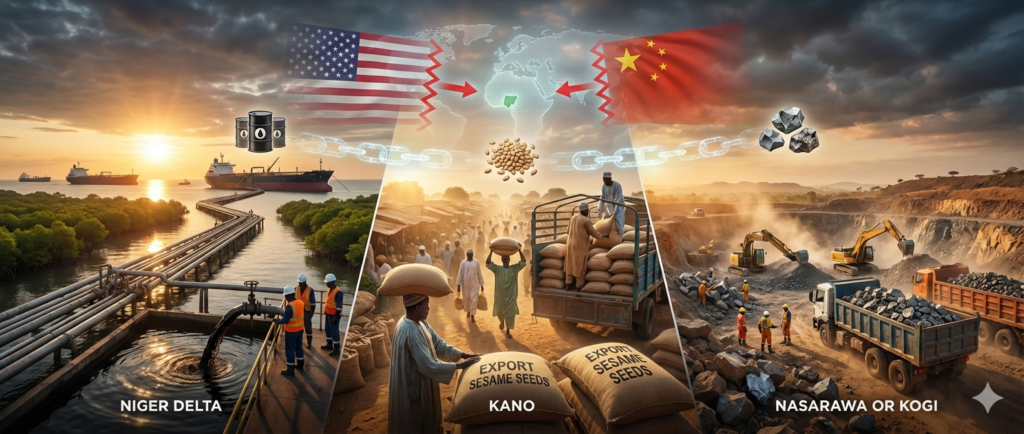
At dawn in the Niger Delta, crude flows through pipelines toward waiting tankers. In Kano, sacks of sesame are stitched for shipment. In Nasarawa and Kogi, solid minerals leave dusty loading bays for distant smelters. These movements appear routine, almost mechanical. Yet their final destination—and their price—are increasingly determined not in Lagos or Abuja, but in Washington and Beijing.
The rivalry between the United States and China has evolved beyond tariffs and technology restrictions; it has become a structural force reshaping global commodity flows. For a country like Nigeria, whose export profile is still dominated by raw materials, this tension is not an abstract geopolitical contest. It is a daily economic reality that influences demand, prices, investment flows, and long-term development prospects.
Both the United States and China occupy strategic positions in Nigeria’s trade architecture. The United States has historically been a major destination for Nigerian exports—primarily crude oil—while China is Nigeria’s largest source of imports and a key infrastructure financier.
This dual dependence places Nigeria in a delicate position. Any disruption in trade relations between the two powers inevitably transmits shocks through commodity prices, supply chains, and investment decisions. Empirical studies show a strong statistical relationship between the US–China trade conflict and Nigeria’s trade performance, macroeconomic stability, and foreign direct investment inflows.
In practical terms, when tariffs rise in one part of the world, the income of a farmer in Benue or an oil worker in Bayelsa can change.
Nigeria’s export earnings remain heavily concentrated in crude oil and other primary commodities. This structure makes the country highly sensitive to global price fluctuations.
Trade tensions between the United States and China often slow global economic growth, reduce industrial output, and weaken energy demand. For an oil-dependent exporter, this translates directly into lower revenue, fiscal pressure, and exchange-rate volatility. Research indicates that commodity price shocks linked to the trade war have had a significant negative effect on Nigeria’s economic stability, particularly through inflation and government income.
Yet the story is not entirely adverse. Simulation studies for Sub-Saharan Africa suggest that trade diversion can increase demand for certain raw materials, especially oil and agricultural products, as China seeks alternative suppliers when its access to US goods is restricted.
This creates a paradox: the same conflict that depresses global demand in the short term can open new export opportunities in the medium term.
When tariffs make US–China trade more expensive, both countries search for alternative partners. For commodity exporters, this can generate unexpected openings.
China’s long-term industrial strategy requires secure access to energy, minerals, and agricultural inputs. In periods of heightened tension with the United States, African suppliers—Nigeria included—become more attractive. Some studies suggest that Nigeria could expand agricultural exports to Asian markets as supply chains reconfigure.
Similarly, selective tariff policies often exempt critical raw materials because advanced economies still depend on them for manufacturing. This underscores the strategic importance of commodity exporters in an era of geoeconomic competition.
However, exporting more raw materials without upgrading domestic processing capacity risks reinforcing the very dependency that limits Nigeria’s long-term growth.
While oil dominates Nigeria’s export earnings, non-oil commodities—such as cocoa, sesame, rubber, and solid minerals—are essential for diversification.
US–China trade tensions increase global shipping costs, disrupt supply chains, and raise the price of imported inputs. Nigerian exporters, who rely heavily on foreign machinery and intermediate goods, face higher production costs as tariffs ripple through global manufacturing networks.
For a small agro-processor, this means thinner margins. For the broader economy, it means reduced competitiveness in global markets.
Trade wars do not only affect goods; they reshape capital movements. Investors respond to uncertainty by delaying projects or shifting funds to safer markets. Studies confirm that global trade tensions influence foreign direct investment inflows into Nigeria by altering risk perceptions.
This matters for commodity exports because large-scale extraction and processing require long-term capital. When investment slows, production capacity stagnates, and Nigeria loses the opportunity to move up the value chain.
A newer dimension of US–China rivalry is the competition for critical minerals and energy resources. Both powers are increasingly seeking direct access to resource-rich regions, including Africa.
For Nigeria, this creates leverage. The country is no longer merely a passive supplier; it is a strategic partner in a contest for resource security. But leverage only translates into development when accompanied by coherent industrial policy, infrastructure, and regulatory stability.
Recent domestic policies—such as efforts to restrict the export of certain raw commodities in order to promote local processing—reflect a growing recognition that exporting unprocessed resources captures only a fraction of their global value.
This approach aligns with the realities of a fragmented global trade system. In a world defined by competing economic blocs, countries that control processing and manufacturing capture more stable income than those that export raw inputs.
Beyond macroeconomic indicators are real livelihoods. When oil prices fall because of global trade tensions, state revenues shrink, public salaries are delayed, and infrastructure projects stall. When Chinese demand for agricultural commodities rises, rural incomes improve, and local economies revive.
The geopolitics of trade therefore shapes the everyday rhythm of Nigerian life—from the price of transport to the availability of jobs.
The US–China trade conflict exposes Nigeria’s structural vulnerability: heavy dependence on a narrow range of primary exports and imported industrial inputs. At the same time, it presents a strategic opportunity to reposition within new global supply chains.
To benefit fully, Nigeria must:
- diversify export markets and products,
- invest in processing and manufacturing capacity,
- strengthen regional trade under African frameworks, and
- negotiate from a position of resource strength rather than dependency.
In conclusion, the impact of US–China trade tensions on Nigeria’s export of raw materials and commodities is neither uniformly negative nor wholly beneficial. It is a complex interplay of price volatility, trade diversion, investment uncertainty, and strategic competition for resources.
What is clear is that Nigeria can no longer view global trade conflicts as distant events. They are already embedded in the country’s fiscal balances, exchange rate movements, and rural incomes.
In the final analysis, the true question is not whether Nigeria will be affected by the rivalry between the world’s two largest economies—it already is. The real question is whether the country will remain a supplier of raw materials whose fortunes rise and fall with external decisions, or whether it will use this period of global realignment to build an economy that trades not only in resources, but in value.